
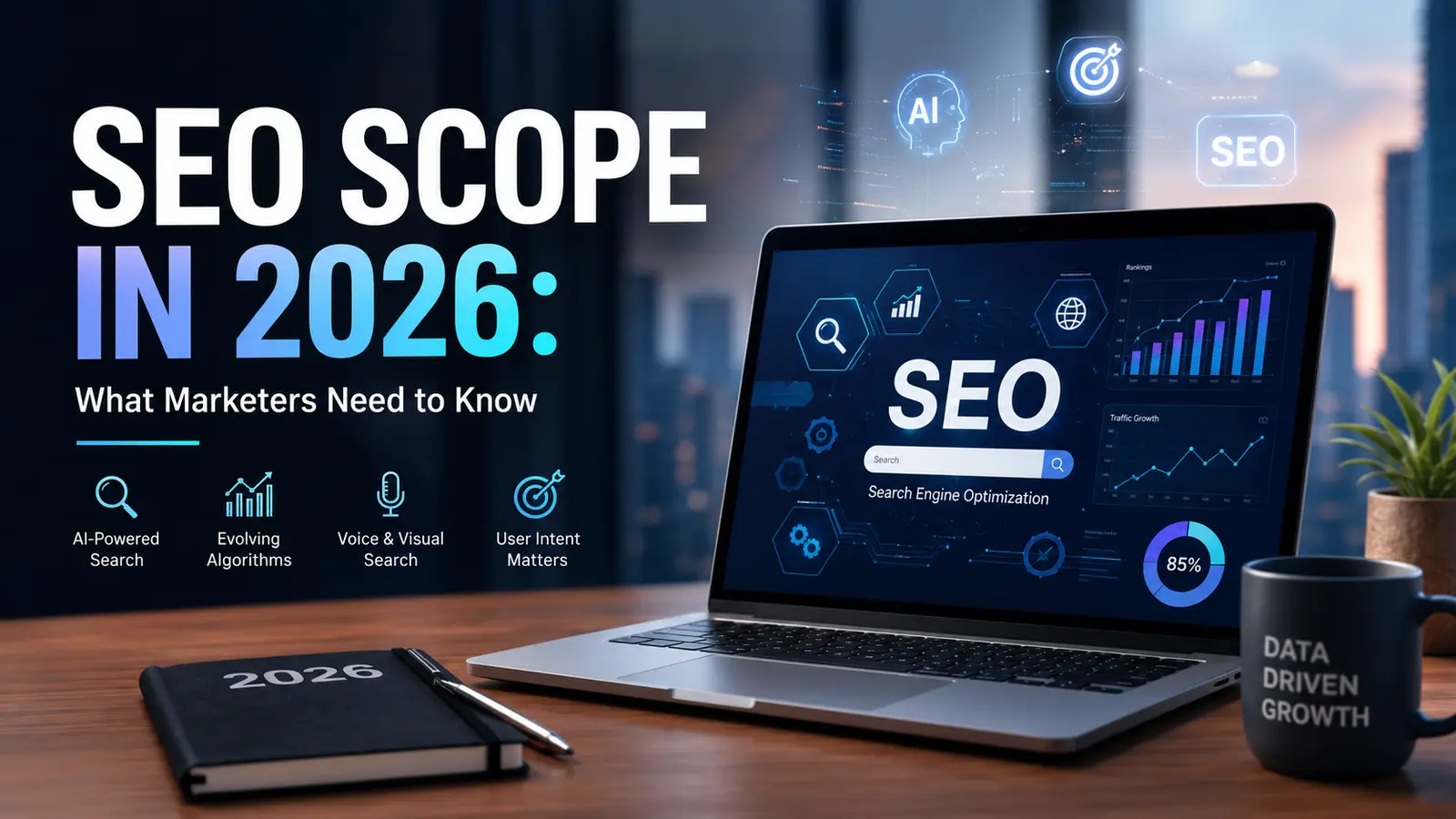
Search in 2026 looks very different from what it did a few years ago. People now discover information through AI overviews, chat-based assistants, voice searches, visual search platforms, and traditional search results. As a result, businesses need to optimize for multiple search experiences instead of relying on a single platform for visibility.
Seo scope in 2026 has expanded far beyond ranking a website on Google. Modern SEO combines content strategy, technical optimization, user experience, data analysis, and AI-driven search trends. For businesses, it has become a long-term growth channel, and for professionals, it remains one of the most in-demand digital marketing skills in the industry.
Why SEO Is Bigger Than Ever, Not Smaller
There’s a persistent myth that AI search killed SEO. The reality is closer to the opposite: AI search multiplied the number of places SEO needs to happen.
Every business that depends on being discovered online e-commerce stores, clinics, schools, SaaS companies, financial services, local shops still needs a strategy for showing up when someone searches for what they offer. The difference is that “showing up” now spans multiple formats: a ranked link, a featured snippet, an AI-generated summary, a voice answer, a video thumbnail, or a personalized recommendation feed.
This expansion is exactly why organizations across nearly every sector continue to invest in search visibility as a core part of their growth strategy. Search remains one of the most cost-effective ways to reach people who are actively looking for a solution, and that incentive hasn’t gone away just because the format of search results has changed.
Think about what organic search actually offers compared to other marketing channels. A paid ad stops working the moment the budget runs out. A social post has a shelf life measured in hours. A well-optimized page, on the other hand, can keep attracting visitors for years with relatively little ongoing investment. That compounding return is precisely why finance teams keep approving SEO budgets even as the tactics underneath those budgets keep shifting. The channel changes; the economics that make it worthwhile do not.
It also helps to remember that search visibility isn’t a single line item it touches product, customer support, PR, and brand strategy all at once. A company’s help-center articles, its product pages, its blog, and even its social presence all feed into how visible and trustworthy it appears across search surfaces. That’s part of why SEO has grown from a niche marketing tactic into something closer to a company-wide discipline, with stakeholders well beyond the marketing department paying attention to how discoverable the business is.
What’s Actually Different About SEO in 2026
The mechanics of optimization have shifted in a few concrete ways.
Search engines now answer instead of just listing. Platforms increasingly generate a direct response to a query rather than handing the user ten links to sort through. That changes what “ranking” even means being the source an AI system pulls from and credits can matter as much as holding the number one organic spot.
Intent matters more than exact phrasing. Search systems have gotten much better at understanding what someone actually means, not just the specific words they typed. A page built around repeating a keyword fifteen times offers little advantage anymore. A page that thoroughly and clearly answers the underlying question does.
Clicks aren’t the only success metric anymore. When a user gets their answer directly in the search results, they may never click through to a website at all. This “zero-click” pattern means visibility and brand recognition increasingly matter alongside traffic numbers. Being seen and trusted is valuable even when it doesn’t show up as a session in your analytics.
Trust signals carry more weight. With so much content now AI-assisted or AI-generated, search systems lean harder on signals of genuine expertise, firsthand experience, and credibility to separate useful content from generic filler.
None of this means SEO fundamentals are obsolete. Technical performance, clear site structure, and well-written content still matter. What’s changed is the bar for what counts as “good enough” and the number of channels you need to account for.
The Trends Shaping Search Right Now
A handful of developments are doing most of the work in reshaping how people find information today.
AI-generated answers are now a default search feature. Rather than being an occasional add-on, AI-written summaries sit at the top of many searches before any traditional results appear. Content that’s organized with clearly direct answers, well-labeled sections, accurate facts has a better chance of being pulled into these summaries.
Zero-click search keeps growing. As answer engines get better, more queries get resolved without a single website visit. This pushes brand visibility and reputation to the forefront, since a user might absorb your brand’s information without ever landing on your site.
Conversational and voice search keep expanding. People talk to search tools the way they’d talk to a person in full sentences, with follow-up questions. Content written in a natural, conversational tone, structured around real questions people ask, tends to perform better in this environment than terse, keyword-heavy copy.
Visual and video content take up more real estate. Image results, video previews, and interactive elements increasingly compete for the same screen space as text links. Brands that produce strong visual and video content pick up visibility that text-only competitors miss.
Personalization is reshaping what “ranking well” even means. Search results increasingly differ from person to person based on location, history, and behavior. There’s less of a single, universal “page one” and more of a tailored experience which means understanding your specific audience matters more than chasing a generic ranking position.
Taken together, these trends point toward a search landscape that rewards specificity over generic breadth. A brand that tries to be visible to everyone, everywhere, with the same undifferentiated content tends to lose ground to competitors who understand exactly who they’re writing for and tailor their presence accordingly across text, voice, image, and video formats simultaneously.
Generative Engine Optimization: The New Layer on Top of SEO
If there’s one concept defining the SEO conversation in 2026, it’s Generative Engine Optimization, or GEO. GEO is the practice of structuring content so that AI systems of the kind powering AI overviews and chat-based answer engines can easily understand it, trust it, and cite it when generating a response.
Traditional SEO and GEO share a lot of DNA, but the goals diverge in a useful way. SEO is largely about earning a position in a results list. GEO is about earning a place inside the answer itself becoming the source an AI system references or quotes when it puts together a response for a user.
A few practices tend to support GEO performance:
- Answering the core question directly and early, rather than burying it under a long introduction.
- Including original data, research, or perspective that doesn’t already exist elsewhere on the web.
- Structuring content with clear headings and logically organized sections, so machines (and humans) can scan it quickly.
- Keeping information current and factually accurate, since outdated or wrong information is a quick way to lose citation eligibility.
- Demonstrating real expertise through author credentials, firsthand experience, or specific detail that generic content lacks.
GEO isn’t a replacement for SEO; it’s better understood as an additional layer that sits on top of the same foundation. A site with weak technical SEO and thin content won’t suddenly succeed at GEO just because someone adds a few headers. The two disciplines reinforce each other.
There’s also a business case for taking GEO seriously beyond just visibility for its own sake. When an AI system cites a brand by name in response to a user’s question, that mention often carries an implicit endorsement the system is, in effect, vouching for the source as reliable enough to quote. For industries where trust is a major purchase factor, like healthcare, finance, or B2B software, that kind of citation can do more for brand credibility than a dozen ordinary search clicks.
It’s also worth noting that GEO is still a young discipline, and best practices are evolving quickly as AI platforms refine how they select and weight sources. Businesses that experiment early and track what gets cited and what doesn’t are building institutional knowledge that’s likely to compound as the practice matures.
Where AI Fits Into the SEO Workflow
AI tools have become a standard part of how SEO work gets done for research, drafting, technical audits, and performance analysis. Keyword research that used to take hours can be compressed into minutes. Technical crawls that once required manual review can be automated and summarized.
But there’s an important caveat that keeps showing up across the industry: content that is obviously AI-generated, generic, and lacking a real point of view tends to underperform. Search systems are specifically tuned to reward material that shows genuine experience and original thinking, and to deprioritize content that reads like a templated summary of other people’s work.
The practical takeaway is that the most effective approach blends AI’s speed with human judgment, voice, and subject-matter knowledge. AI can draft an outline, summarize research, or flag technical issues. A person still needs to bring the insight, the editorial judgment, and the credibility that make content worth trusting and worth citing.
This balance plays out differently depending on the size of the team. A solo content creator might lean on AI heavily for first drafts and research synthesis, then spend most of their own time on fact-checking, adding personal experience, and sharpening the angle. A larger marketing team might use AI primarily for scale, running technical audits across thousands of pages, or generating first-pass briefs for writers while reserving human time for the strategic decisions about what to cover and how to position it. Either way, the teams getting the best results tend to treat AI as a force multiplier for their existing expertise rather than a substitute for having expertise in the first place.
What Still Determines Rankings
Despite all the change at the surface level, a consistent set of fundamentals continues to anchor how search systems evaluate content.
Experience, expertise, authority, and trust remain central. Search systems favor content that’s clearly produced by someone with real knowledge or hands-on experience in the subject, rather than content that simply repackages existing information.
Topical depth beats scattered keyword targeting. Sites that build out comprehensive coverage of a subject area tend to outperform sites chasing isolated keyword opportunities one page at a time. Depth and consistency around a topic signal authority in a way that one-off articles cannot.
Engagement signals still matter. How long people stay on a page, whether they interact with it, and whether it actually satisfies their question all feed back into how search systems judge quality.
Technical health is non-negotiable. Site speed, mobile usability, secure connections, and clean site architecture remain baseline requirements. No amount of clever content strategy compensates for a site that loads slowly or breaks on a phone.
Original, well-researched content wins over generic filler. This has arguably become more true, not less, as the web fills up with AI-assisted content that says very little that’s new.
Practical Strategies Worth Prioritizing
For businesses and marketers trying to translate all of this into action, a few priorities consistently pay off.
Start with user intent rather than a keyword list. Understand the actual problem someone is trying to solve when they search, and build content that solves it clearly, rather than working backward from a phrase you want to rank for.
Put the most useful information early. Whether a human or an AI system is reading the page, leading with a direct, clear answer improves the odds of both a good user experience and a citation in an AI-generated summary.
Build topic clusters instead of isolated posts. A network of interlinked content around a central subject does more for authority than a handful of disconnected articles ever could.
Use structured data deliberately. Schema markup helps search engines parse what a page is actually about, and it can unlock richer, more visible results.
Tighten internal linking. A site that’s easy to navigate for both users and crawlers tends to perform better across the board, and it helps distribute authority to deeper pages that would otherwise be overlooked.
The Toolkit SEO Professionals Rely On
The tools that support SEO work in 2026 fall into a few overlapping categories. Foundational platforms like Google Search Console remain essential for monitoring how a site is actually performing in search and catching technical issues early. Established analytics and competitive research tools continue to provide insight into backlinks, keyword performance, and competitor positioning.
Alongside these, a newer generation of AI-assisted platforms helps with content optimization and, increasingly, with tracking how often and how accurately a brand gets referenced inside AI-generated answers a category of tracking that didn’t meaningfully exist a few years ago. Together, these tools let marketers move faster and base decisions on real data rather than guesswork.
Career Paths Worth Watching
The job market reflects how much SEO has diversified. Rather than a single generalist role, the field now supports a range of specializations: technical SEO experts who focus on site architecture and performance, content strategists who own the editorial and topical authority side, analysts who track and interpret performance data, and a newer category of specialists focused specifically on optimizing for AI-driven search and generative engines.
People who combine strength in content strategy with technical fluency and comfort using AI tools tend to be the most competitive candidates, since the role increasingly asks for breadth across disciplines that used to be more siloed.
Looking Past 2026
The longer-term trajectory points toward something broader than search engine optimization in the narrow sense more like “search experience optimization,” covering everything from traditional search engines to AI assistants, voice interfaces, and conversational platforms all at once.
The throughline across all of it stays remarkably stable: deliver information that’s genuinely useful, accurate, and trustworthy, and adapt the format to wherever people are actually looking for it. The channels keep multiplying. The underlying goal being a reliable answer to a real question hasn’t changed at all.
1. What is the SEO scope in 2026?
The SEO scope in 2026 is extremely broad as businesses increasingly rely on digital marketing, AI-powered search, and organic traffic. SEO now includes content optimization, technical SEO, AI search visibility, voice search optimization, and user experience improvement across multiple platforms.
Faq
2. Is SEO still a good career option in 2026?
Yes, SEO remains one of the most promising digital marketing careers in 2026. Companies across industries such as e-commerce, healthcare, education, finance, and technology are actively hiring SEO specialists, content strategists, and technical SEO experts to improve online visibility.
3. How has SEO changed in 2026?
SEO has evolved from simple keyword optimization to a comprehensive search experience strategy. AI-powered search results, Google AI Overviews, conversational search, and personalized search experiences have made user intent, content quality, and authority more important than keyword density.
4. What is Generative Engine Optimization (GEO)?
Generative Engine Optimization (GEO) is the process of optimizing content so that AI platforms like ChatGPT, Google AI Overviews, Gemini, and Perplexity can easily understand, reference, and cite it in their generated answers. GEO is becoming an important part of modern SEO strategies in 2026.
5. What are the top SEO trends in 2026?
The major SEO trends in 2026 include AI-powered search results, zero-click searches, voice and conversational search, visual and video search optimization, personalized search experiences, and the growing importance of GEO for AI-driven search platforms.
6. Which SEO skills are most important in 2026?
The most valuable SEO skills in 2026 include content strategy, technical SEO, data analysis, AI tool proficiency, keyword research, user intent optimization, schema markup implementation, and the ability to create original, authoritative content.
7. Can AI replace SEO professionals in 2026?
No, AI is changing how SEO professionals work, but it is not replacing them. AI tools can help with research, content planning, and technical analysis, while human expertise is still essential for strategy, creativity, original insights, and understanding audience needs.
8. What industries have the highest demand for SEO in 2026?
Industries with strong SEO demand in 2026 include e-commerce, healthcare, education, finance, SaaS, real estate, travel, and technology. These industries depend heavily on online visibility, lead generation, and organic traffic growth.
9. What are the best SEO tools to use in 2026?
Popular SEO tools in 2026 include Google Search Console, Ahrefs, SEMrush, Surfer SEO, Frase, and AI-powered optimization platforms. These tools help marketers analyze rankings, backlinks, technical issues, content performance, and AI search visibility.
10. What is the future of SEO beyond 2026?
The future of SEO will focus on search experience optimization across search engines, AI assistants, voice platforms, and conversational interfaces. Businesses that create high-quality, trustworthy, and user-focused content while adapting to AI-driven search technologies will continue to achieve strong online visibility and growth.
11. Is joining a Digital Marketing Course beneficial for learning SEO in 2026?
Yes, joining a Digital Marketing Course is beneficial for learning SEO in 2026. It helps you understand modern SEO techniques, including AI-driven search, content optimization, and technical SEO. You also gain hands-on experience with industry tools and real-world projects. This can improve your career opportunities and help you stay competitive in the evolving digital marketing landscape.
Explore Trending Courses ➔
Conclusion
SEO in 2026 isn’t smaller or less relevant; it’s more layered. Businesses now have to think about traditional rankings, AI-generated answers, voice queries, visual search, and personalized results all at once, rather than optimizing for a single results page. That complexity is exactly what makes skilled SEO professionals valuable and what makes a clear, intentional strategy worth the investment, whether you’re running a business or building a career in this space.
Read more:- Best Jobs after Digital Marketing Course