
You’ve probably read five articles already that end with “it depends.” Fair, it does depend. But you didn’t come here for a shrug. You came here for numbers you can actually act on.
Node.js and Django are both real, working career paths in 2026. One’s JavaScript running on a server. The other’s Python is wearing a framework. Pick either and you can land a backend job within a year. Pick without checking your own goals first, and you’ll spend six months relearning things you could have sorted out today.
This is a plain comparison: node js vs django on architecture, learning curve, pay, and job openings, based on what Appwars Technologies sees across its own Node.js and Django batches in Noida, not just what the documentation says.
What is Node.js, in plain terms
Node.js is a runtime, not a language. It takes JavaScript, the language your browser already speaks, and lets it run on a server.
Ryan Dahl built it in 2009 on Chrome’s V8 engine. The idea was simple: one language for the frontend and the backend, no context switching between two syntaxes in the same afternoon.
Node.js handles requests through an event loop instead of opening a new thread for every single one. That’s why apps like Netflix and PayPal lean on it for anything that needs to move fast under heavy traffic. Netflix cut its own startup time from 40 minutes to under a minute after moving to Node.js, a detail worth remembering the next time someone claims Node can’t handle scale.
If you already know JavaScript from building web pages, Node.js training in Noida is usually the shortest bridge from frontend work into full backend development.
What is Django, in plain terms?
Django is a Python framework: it ships with an ORM, an admin panel, built-in authentication, and a folder structure that tells you exactly where each piece of code belongs.
Instagram, Spotify’s internal tools, and Pinterest all started on Django. The framework’s whole pitch is “batteries included.” You’re not stitching together 15 separate libraries before writing your first working route.
Django runs on a synchronous, request-response model by default (async support exists, but it’s not the default mindset the way it is with Node.js). That makes it a touch slower under massive concurrent load and considerably faster to build with when you’re a small team trying to ship features this month, not next quarter.
If Python is already your language, or you want Python because of where else it shows up (data science, automation, AI), Django training in Noida keeps you inside one language for backend work and beyond.
Get Free Career Counseling ➔Node.js vs Django: the core difference
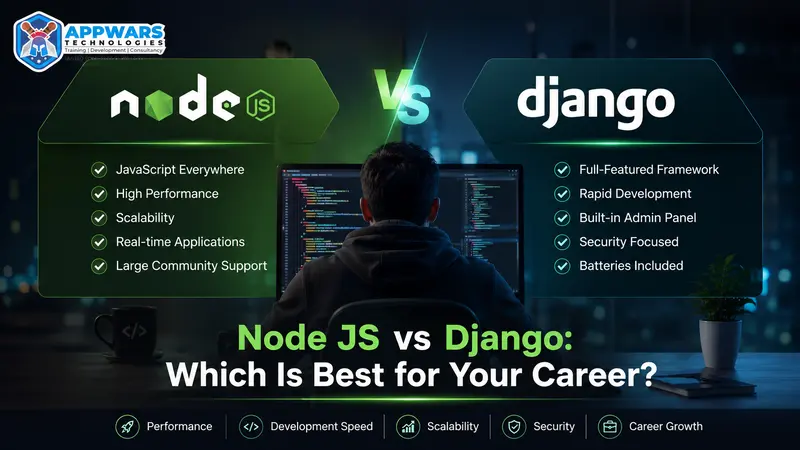
Here’s the one-line version. Node.js is JavaScript, event-driven, built for apps that need to juggle thousands of simultaneous connections without blocking. Django is Python, structured, and built to get a working product out the door fast with fewer decisions along the way.
Everything else in this comparison branches off that single line.
| Factor | Node.js | Django |
|---|---|---|
| Type | Runtime environment | Web framework |
| Language | JavaScript | Python |
| Architecture | Event-driven, non-blocking | Synchronous by default (async optional) |
| First released | 2009 | 2005 |
| Best suited for | Real-time apps, APIs, microservices | Content-heavy sites, admin tools, rapid builds |
| Package manager | npm | pip |
| Learning curve | Easier if you know JavaScript | Easier for absolute beginners |
Node.js vs Django for backend development
This is where students get stuck, because “backend development” means different things depending on what you’re actually building.
Node.js for backend work:
- Handles thousands of open connections without blocking, useful for chat apps, live dashboards, and streaming data
- Shares one language with your React or Angular frontend, so switching between the two costs almost nothing
- Stays unopinionated: Express, Fastify, and NestJS all structure things differently, so your team decides the architecture
- Runs on npm, a huge but uneven ecosystem, you’ll spend real time vetting which packages are worth trusting
Django for backend work:
- Ships with an admin panel out of the box, genuinely useful for internal tools and CMS-style products
- Handles database work through its ORM, so you’re writing far less raw SQL
- Comes with built-in protection against SQL injection, CSRF, and clickjacking; security isn’t an afterthought here
- Keeps an opinionated structure, less debate about where files go, less flexibility if you want to do it differently
If your product needs real-time features (chat, live scores, notifications), node js vs django for backend usually tips toward Node.js. If you’re building a data-heavy admin system with a small team and a tight deadline, Django takes that round.
Node.js vs Django salary in India
Money’s the real question, so here it is straight.
| Experience level | Node.js developer (annual CTC) | Django developer (annual CTC) |
|---|---|---|
| Fresher (0-1 yr) | ₹3-4.5 LPA | ₹3-6 LPA |
| Mid-level (2-5 yrs) | ₹5.5-9 LPA | ₹4.5-7 LPA |
| Senior (5+ yrs, cloud/system design) | ₹18-25+ LPA | ₹20-25+ LPA |
| Full stack (React or DRF added) | 25-40% higher than base | 25-40% higher than base |
(Figures pulled from Glassdoor and Guvi’s 2026 India salary reports, rounded for readability.)
Node js vs django salary numbers land close enough that pay alone shouldn’t decide this for you. What actually moves the needle in both stacks is what you pair with the core skill. Cloud platforms and system design push Node.js pay up. Django REST Framework and cloud do the same for Django. Add either one, and five years in, you’re looking at similar money regardless of which door you walked through first.
Node.js vs Python Django: performance and scalability
People searching node js vs python django are usually asking one thing underneath it all: which one holds up when traffic spikes?
Short version: Node.js handles concurrent I/O better by default. Its non-blocking model means one slow database call doesn’t freeze the server for every other user waiting in line. That’s why teams building chat, gaming, or real-time analytics tools reach for it first.
Django scales too; Instagram’s user base alone proves that, but it takes deliberate work: caching layers, async views, and load balancing configured on purpose instead of coming free out of the box.
For raw computation (data processing, machine learning pipelines), Python’s ecosystem still leads regardless of which web framework sits on top of it. That’s a separate question from Django specifically, but it explains why teams doing both web and data work often keep Python in the stack even after the web layer eventually gets rebuilt elsewhere.
Get Free Demo Class ➔Which is easier to learn, Node js or Django?
Neither one is genuinely easy, but the on-ramps look different depending on where you’re starting from.
Node.js comes easier if you already know JavaScript. You’re reusing syntax and mental models you already have, mostly learning server-side concepts (routing, middleware, async patterns) rather than a whole new language on top of new concepts.
Django comes easier for absolute beginners with zero programming background. Python reads close to plain English, and Django’s structure removes a lot of the “where does this file even go” confusion that trips up new backend developers in their first month.
Most Appwars trainers point complete beginners toward Python training in Noida and Django first, then Node.js later once backend fundamentals are solid. Students who already write JavaScript for frontend work usually skip straight to Node.js.
How long it takes to get job-ready
| Starting point | Path | Rough timeline |
|---|---|---|
| Know JavaScript already. | Node.js + Express, then MongoDB or PostgreSQL | 3-4 months |
| Complete beginner | Python basics, then Django | 4-6 months |
| Want full-stack, JavaScript-only | Node.js + React (MERN stack) | 5-7 months |
| Want full-stack, Python-heavy | Django + DRF + a JS frontend | 5-7 months |
These numbers assume consistent daily practice and at least 2-3 real projects, not just finished course videos. A finished course without a project on GitHub reads the same as an unfinished one to most hiring managers.
Job market: where each one gets you hired
Node.js shows up constantly in startup job postings, especially anywhere the team already runs React. That combination, MongoDB, Express, React, and Node.js, is what people mean by the MERN stack, and it dominates a large share of startup and product-company listings in Noida, Gurgaon, and Bangalore. Anyone comparing a MERN stack course against a Node.js-only track should know the MERN path is really Node.js plus a matching frontend, aimed squarely at those full-stack listings.
Django shows up more in fintech, healthtech, and data-adjacent companies, places that already run Python for data science or automation and want the web layer speaking the same language. Government and research-adjacent projects lean Django too, since the built-in security defaults matter more in those settings.
Neither market is bigger in a way that should make this decision for you. Both have more open roles than qualified candidates right now. Recruiters at Appwars placement drives say the same thing about both stacks: candidates who ship real projects beat candidates who only finished the course every single time.
Common myths about node js vs django
Myth: Node.js is only for startups. Reality: Netflix, PayPal, LinkedIn, and Uber all run Node.js in production at a serious scale. Startups adopted it early because it’s fast to build with, not because it caps out at startup size.
Myth: Django is outdated because it’s from 2005. Reality: Instagram runs on Django today, serving hundreds of millions of users. Age doesn’t equal obsolescence; plenty of frameworks released after Django have already come and gone.
Myth: You have to pick one and stick with it forever. Reality: A lot of working professionals learn both, sequenced a year or two apart. Django (through Python) helps with automation and data work. Node.js helps with full-stack JavaScript roles. They don’t compete for the same hours if you plan the order sensibly.
Django vs Node.js: Which should you pick for your career?
Boiled down, django vs node js comes down to two questions: what are you building, and what do you already know? Answer those honestly, and the rest sort itself out.
Pick Node.js if:
- You already know JavaScript or want one language across frontend and backend
- Startups, real-time apps, or full-stack roles appeal to you
- You’re planning to pair it with React through a MERN stack course
Pick Django if:
- Python is your first language, or you want it for data science and AI down the line
- You want structure and fewer setup decisions while you’re still learning the ropes
- Fintech, healthtech, or data-heavy companies are on your target list
Both are legitimate careers with a decade of runway ahead of them. The developers who struggle aren’t the ones who picked “wrong.” They’re the ones who picked, then spent six months second-guessing instead of building something real.
Explore Trending Courses ➔Frequently asked questions
Is Node.js or Django better for backend development?
Node.js suits real-time, high-concurrency apps. Django suits content-heavy or admin-driven products you need to build fast. Which one’s “better” depends on what you’re shipping, not which one launched more recently.
Does Node.js pay more than Django in India?
Not by much. Fresher and mid-level pay overlaps heavily across node js vs django salary bands. Senior pay in both stacks depends more on added skills (cloud, system design, React, or DRF) than on the base technology itself.
Can I learn both Node.js and Django?
Yes, plenty of working professionals do exactly that. Django and Python help with automation and data work. Node.js helps with full-stack JavaScript roles. Sequence them a year apart, and they build on each other instead of competing.
Which is better for a first job, Node.js or Django?
If you already know JavaScript, Node.js gets you job-ready faster. If you’re starting from zero, Django’s structure and Python’s simpler syntax usually get first-time coders shipping something real sooner.
Is Django only useful if I already know Python?
No, plenty of students start Django and Python together as their first language. Learning Django effectively means learning Python at the same time, and Python opens doors well beyond web development, including data analytics and machine learning.
Do I need a computer science degree for either one?
No. Most working developers in both stacks are self-taught or came through short-format training. Projects and a working GitHub profile carry far more weight in interviews than the degree on your resume.
Final take
There’s no universal winner in node js vs django. There’s only the better fit for what you’re building and what you already know walking in.
If you’re still unsure, sit in on a trial class for both before committing months to either one. Appwars runs live Node.js and Django batches out of the same Noida campus, and 45 minutes in a real classroom tells you more than another month of reading comparison articles.