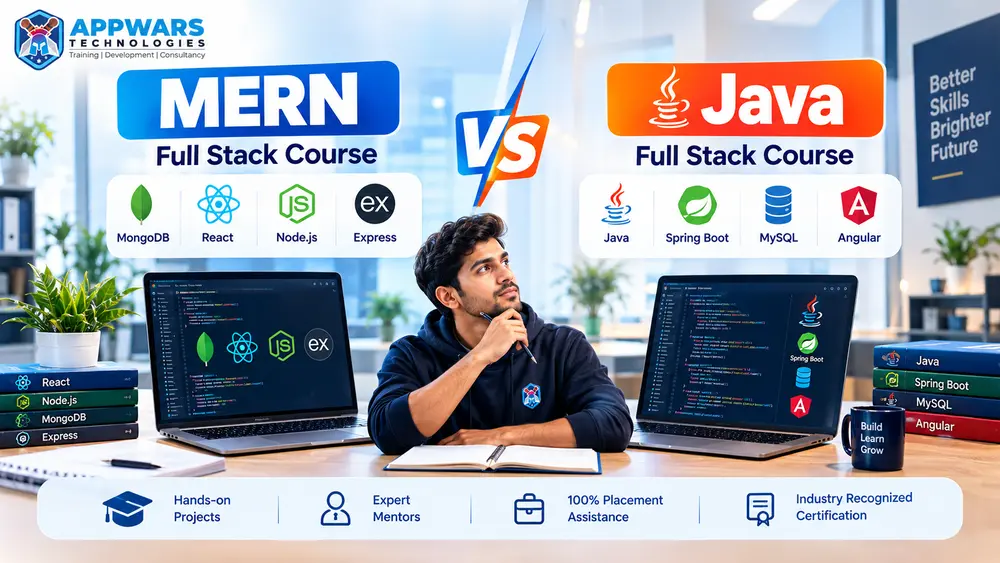
Choosing between a MERN vs Java full stack course is the first real career decision most coding students face. The internet answers it with opinions. This guide answers it with fee ranges, salary figures from July 2026, syllabus differences and a simple method to decide.
Short version: pick MERN if you want to ship web products fast and enjoy JavaScript. Pick Java if you are aiming at banks, insurers, large IT services firms, or enterprise product teams, and you can handle a steeper first 3 months. Both paths lead to paid developer jobs in Noida, Delhi NCR and beyond.
This MERN vs Java full stack course guide is written for students, career switchers and working professionals who want a decision they can defend in an interview.
Quick answer: MERN vs Java full stack course by situation
| Your situation | Better fit |
|---|---|
| Non-IT background, want a first developer job quickly | MERN |
| B.Tech, BCA or MCA student who already studied Java | Java full stack |
| Want startup, agency or freelance work | MERN |
| Targeting banks, insurance, telecom or big service companies | Java full stack |
| Working professional moving from testing or support | MERN (usually quicker) |
| Want deep backend and system design skills over time | Java full stack |
Use this table as a first filter for your MERN vs Java full stack course choice, then check the details below. If your row says MERN, read the MERN Stack Development Training in Noida page next. If it says Java, start with the Java Full Stack course page.
Get Free Career Counseling ➔What each stack actually covers
A MERN vs Java full stack course teaches the same job skill, building complete web applications, with different tools.
MERN stands for MongoDB, Express.js, React and Node.js. You write JavaScript on the browser side, the server side and in database queries. One language, four tools.
Stack Overflow’s 2025 Developer Survey (49,000+ respondents) put JavaScript at 66% usage, Node.js at 49.1% and React at 46.9% among web technologies. That is a big pool of employers and a big pool of competitors.
Java full stack pairs Java on the server with a front-end layer. A typical course teaches Core Java, JDBC, Hibernate or JPA, Spring Boot, REST APIs, a SQL database such as MySQL, and a front-end framework (React or Angular). Spring Boot shows up at roughly 15% in the same survey, a smaller share than Node.js, but it sits deep inside banks, insurers and large service firms where systems live for 10 years or more.
Notice the overlap. Most Java full stack syllabi teach React for the screen layer, so React skills carry over to both tracks.
MERN vs Java full stack course: side-by-side comparison
| Factor | MERN stack | Java full stack |
|---|---|---|
| Main language | JavaScript (TypeScript optional) | Java |
| Backend | Node.js + Express.js | Spring Boot |
| Database | MongoDB (document store) | MySQL or PostgreSQL (relational) |
| Front-end | React | React or Angular |
| Typing | Loose, flexible | Strict, checked at compile time |
| First 3 months | Faster visible results | Slower, more theory |
| Typical course length | 4 to 6 months | 5 to 7 months |
| Common employers | Startups, agencies, product teams | Banks, enterprises, IT services |
| Interview focus | JavaScript, React, REST, async code | OOP, collections, Spring, SQL |
| Freelancing | Easy to start | Harder to start |
Read every row of this MERN vs Java full stack course comparison as a trade-off. Course length varies by institute. Java usually runs longer because Core Java and Advanced Java come before Spring Boot.
MERN course vs Java full stack course: syllabus and learning curve
What a solid MERN syllabus includes
- HTML, CSS and modern JavaScript (ES6+), including promises and async/await
- Git and GitHub
- React: components, hooks, routing, state management
- Node.js and Express.js: routing, middleware, REST APIs
- MongoDB and Mongoose: schema design, queries, indexes
- Authentication with JWT, plus basic security
- Deployment on a cloud platform
- A capstone project with a live link
What a solid Java full stack syllabus includes
- Core Java and OOP, collections, exceptions, multithreading basics
- SQL, JDBC and Hibernate or JPA
- Spring Core, Spring Boot, Spring Data and Spring Security
- REST API design, Maven, Postman, JUnit
- HTML, CSS, JavaScript and React or Angular
- Intro to microservices and Docker
- A capstone project with a live link
Which is harder to learn?
Difficulty is where a MERN vs Java full stack course decision usually gets stuck, so here is a straight answer.
Java is harder in the first 3 months. The language is verbose, Spring annotations feel like magic until someone explains the container underneath, and you write a lot of code before anything appears on screen.
MERN is easier to start and easier to get wrong. JavaScript lets you build a working page in week 2, but async code, state management and a sprawling npm ecosystem trip up beginners. Messy folder structures are common.
My take: Java makes better programmers sooner, and MERN makes working demos sooner. Which one matters more depends on whether your goal is a portfolio next month or a strong foundation by next year.
For a deeper roadmap on either track, read the MERN Stack Developer Roadmap 2025 and the Spring Boot Roadmap.
Get Free Demo Class ➔MERN Stack vs Java Full Stack Course Fees in 2026
Fees depend more on the institute, batch size, mode, and placement support than on the stack itself. Classroom hours drive most of the price, and the two tracks often run a similar number of hours. Ask for both quotes in writing before you decide. A MERN vs Java full stack course priced under ₹25,000 deserves extra questions about live hours and batch size.
Here are public price points we found while researching this MERN vs Java full stack course post:
| Program type | Fee listed | Duration |
|---|---|---|
| Noida classroom MERN course (Appwars Technologies) | ₹41,300 | 6 months |
| Online part-time AI engineering program covering Java or MERN | ₹75,000 incl. GST | 6 months |
| University-linked online MERN certificate (IIT Kanpur eICT) | ₹1,53,400 incl. GST | 180+ hours, 3 to 5 months |
| Global online Java full stack master’s program | US$1,449 | 7 months |
Prices change with every batch, so treat this table as a range finder for any MERN vs Java full stack course and confirm current fees with the institute.
How to compare fees across a MERN vs Java full stack course
- Divide fee by classroom hours. A ₹40,000 course with 240 live hours costs about ₹167 per hour. A ₹30,000 course with 120 hours costs ₹250 per hour.
- Count the extras. Ask whether placement support, certification, and project mentoring are included.
- Check the laptop requirement. Java with an IDE like IntelliJ and Docker runs better on 16 GB RAM. MERN works on 8 GB.
- Ask about repeat batches. Some institutes let you re-attend a module for free.
If you are weighing a MERN stack vs Java full stack course fee quote from Appwars Technologies against others, check the current fee on each course page and ask the counsellor which hours are live versus recorded.
Salary and job demand: MERN vs Java full stack course outcomes
Salary data online is messy. Each site collects it differently, so compare rows inside one source rather than across sources. Check outcomes before you pay for any MERN vs Java full stack course.
| Source | Stack | What it reports |
|---|---|---|
| Glassdoor India, Jul 2026 (741 salaries) | Java full stack | Typical base: ₹4L to ₹7L, average ₹5L, about ₹50K extra pay |
| Glassdoor India, Jul 2026 (another cut) | Java full stack | Average ₹5.4L, top 10% at ₹13.5L |
| Jooble India, Jul 2026 | MERN | ₹5.7L to ₹7.3L, average about ₹7L |
| Simplilearn citing AmbitionBox | MERN | Average of about ₹5L |
| Cutshort | MERN | 2 years’ experience: ₹7.2L to ₹18L, average ₹10.8L (companies that hire strong tech talent) |
| Flexiple, Aug 2026 | MERN | Top 10% earn ₹19.2L+ |
What the numbers say about a MERN vs Java full stack course: freshers in both stacks commonly see ₹3L to ₹6L offers. Senior pay climbs past ₹15L in both, and a few Bengaluru Java submissions on Glassdoor reach ₹25L to ₹26L at 10+ years (a tiny sample, so don’t plan around it).
Employer type moves your salary more than the stack. A MERN developer at a funded product company can out-earn a Java developer at a small service shop, and the reverse also happens. Think of the MERN course vs Java full stack course choice as a bet on which employer type you want to work for.
Where the jobs sit
Job demand behind a MERN vs Java full stack course differs by employer type.
- MERN: startups, SaaS products, digital agencies, e-commerce teams, freelance clients
- Java full stack: banking and insurance technology, large IT services, telecom, enterprise product companies
Delhi NCR has both kinds of employers within one metro ride of each other, so neither choice locks you out of local hiring. If you want to see the next step in a Java career, the Advance Java Training in Noida page lists what comes after the basics.
MERN Stack Course vs Java Full Stack Course: Who Should Choose What?
Every MERN vs Java full stack course choice depends on the learner’s starting point.
| Profile | Lean towards | Why |
|---|---|---|
| Class 12, or first-year BCA/B.Sc. student | Java full stack, if you can commit 6+ months | Strong fundamentals pay off for 10 years. |
| Final-year B.Tech/MCA with campus drives ahead | Match the campus recruiters. | Service firms test Java: startups test JavaScript. |
| Non-IT graduate switching careers | MERN | Single language, faster first project |
| Working professional with 2 to 5 hours a week | MERN | A shorter feedback loop keeps motivation up. |
| The developer is already writing Python or PHP. | MERN | JavaScript is the quickest second language. |
| Developer who wants backend depth | Java full stack | Spring teaches layered design. |
For freshers, a MERN Stack Course vs Java Full Stack Course decision is mostly a question of how many months you can study before you need a salary.
Comparing a Java vs Python decision as well? That post covers the language question that sits underneath this one. And if you are torn between Node and a Python backend, read Node js vs Django.
Explore Trending Courses ➔A 4-step method to settle the MERN vs Java full stack course question in one weekend
Run this test before paying for a MERN full Stack Course vs Java Full Stack Course.
- Read 20 job posts for each stack. Search your city on a job portal for “MERN stack developer” and “Java full stack developer”. Note the employer type and the skills repeated most often. This takes 30 minutes.
- Build one tiny API in each. Follow a free tutorial for an Express “hello” endpoint, then a Spring Boot one. Spend 2 to 3 hours on each. Notice which one frustrates you less.
- Check your campus or city reality. If recruiters visiting your college come from large IT services firms, lean Java. If your network is full of startup founders, lean MERN.
- Pick one and commit for 6 months. Switching at month 2 costs more than a slightly imperfect choice.
Does AI change the MERN vs Java full stack course decision?
A little. AI coding assistants write boilerplate in both stacks, so memorizing syntax matters less than before. A MERN vs Java full stack course in 2026 should include practice with AI-assisted coding, plus the fundamentals to review what the assistant writes. Java’s strict typing catches some AI mistakes at compile time, while JavaScript needs tests and discipline to catch the same errors. See our list of the 10 best AI tools for coding in 2026 before you start.
Mistakes to avoid before joining a MERN vs Java full stack course
- Choosing by hype on social media instead of local job posts
- Skipping SQL (it matters for MERN too, since many employers still run relational databases)
- Building 8 clone to-do apps instead of 2 deeper projects
- Ignoring data structures and algorithms (read the DSA Roadmap for Placements)
- Joining without attending a demo class
- Collecting certificates with no deployed project to show
Skills to add after a MERN vs Java full stack course
| Skill | Helps MERN | Helps Java |
|---|---|---|
| Git and GitHub | Yes | Yes |
| SQL fundamentals | Yes | Yes |
| DSA basics | Yes | Yes |
| TypeScript | Yes | Optional |
| JUnit and testing | Jest | JUnit |
| Docker and cloud basics | Yes | Yes |
The add-on skills overlap heavily, which is one more reason the first pick matters less than finishing it. Cloud basics pair well with both. The AWS Training in Noida page covers the deployment side.
How to judge a MERN vs Java full stack course before paying
Use this checklist at the demo class:
- Is the trainer a working or former developer who can show real code, not slides?
- Was the syllabus updated recently (React 19, Spring Boot 3)?
- How many projects are deployed with live links?
- What is the batch size, and how fast do doubts get answered?
- Can you speak to 3 alumni on LinkedIn about placement claims?
- What is the refund or batch-change policy in writing?
Appwars Technologies teaches both a MERN Stack course and a Java Full Stack course at C-20, 1st Floor, Sector 2, Noida (near Noida Sector 15 Metro). Compare the two syllabus pages side by side, then ask the counsellor your fee and batch questions. You can also browse the full Full Stack Development course overview or return to the Appwars Technologies homepage.
Pick by your goal, run the weekend test and book one demo class for each stack. That settles a MERN vs Java full stack course debate faster than another week of reading.
FAQs on MERN vs Java full stack course
Which is better in a MERN vs Java full stack course comparison?
Each wins in its own territory. MERN fits startups, agencies and fast product work. Java full stack fits enterprise, banking and large service companies. Use the 4-step method above.
Is a MERN Stack Course vs Java Full Stack Course easier for beginners?
MERN is easier in the first 3 months because you use one language and see results fast. Java is harder at the start but gives stronger fundamentals.
MERN Stack vs Java Full Stack Course Fees: which costs more?
Fees track hours, mode and placement support more than the stack. Java courses often run longer, which can raise the price. Compare cost per live hour.
Which pays more after a MERN vs Java full stack course?
Entry-level pay overlaps at ₹3L to ₹6L in most cities. After 3 to 5 years, employer type and skill depth matter more than the stack.
Can non-IT students learn a MERN full Stack Course vs Java Full Stack Course?
Yes, either works. Most non-IT learners finish MERN faster because they only learn one language. Java needs more patience but is fully learnable in 6 to 7 months.
Can I switch from MERN to Java full stack later?
Yes. SQL, Git, REST concepts and React transfer directly. Plan 2 to 3 months to learn Java and Spring Boot.
Is Java still worth learning in 2026?
Yes. Large enterprises still run huge Java codebases, and Spring Boot keeps getting new releases and new hires.