If you’ve sat through a coding round and blanked on a simple array question, you’re not the only one. Every placement season, thousands of computer science students and working professionals walk into technical interviews with strong theoretical knowledge and weak problem-solving instincts. A DSA roadmap fixes that gap. It’s the difference between “I know Java” and “I can solve this problem with Java in 20 minutes.”
This guide lays out a complete DSA roadmap for placements, structured by topic, by week, and by skill level. Whether you’re a final-year student prepping for campus drives or a developer switching jobs, you’ll find a path that fits your timeline. Trainers who run placement batches at institutes like Appwars Technologies see the same pattern every semester: students who follow a structured order clear technical rounds faster than students who jump between random topics on YouTube.
What a DSA roadmap actually covers
DSA stands for data structures and algorithms. It’s the backbone of almost every technical interview at product-based companies: Amazon, Microsoft, Google, Flipkart, Adobe, and dozens of Indian startups that hire through campus placements or lateral drives. Service-based companies test it too, though usually at an easier level.
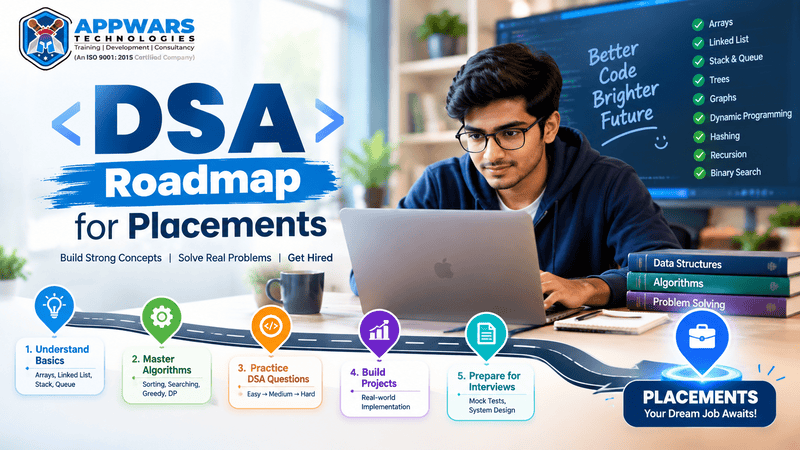
A roadmap isn’t a syllabus you memorize. It’s an order of operations. Learn arrays before trees. Learn recursion before dynamic programming. Skip the order, and you’ll spend weeks stuck on problems that assume knowledge you don’t have yet.
Here’s what a solid DSA preparation roadmap includes:
- Core data structures: arrays, strings, linked lists, stacks, queues, trees, graphs, hash maps
- Algorithmic techniques: sorting, searching, recursion, backtracking, greedy methods, dynamic programming
- Problem-solving patterns: two pointers, sliding window, binary search on answer, divide and conquer
- Time and space complexity analysis
- Mock interviews and timed practice under pressure
Miss the last point and the rest barely matters. Interviewers care as much about how you think out loud as whether your code compiles.
Why placements need a different roadmap for students
A general DSA roadmap for developers assumes you already code daily and just need to sharpen problem-solving. A DSA roadmap for students has to start earlier: syntax comfort, basic logic building, and confidence in at least one programming language before touching a single interview problem.
That’s why the plan below splits into two tracks further down this page. Pick the one that matches where you actually are right now, not where you wish you were. A first-year or second-year student has the luxury of stretching this roadmap across 2 semesters, picking up 1 or 2 topics per month alongside coursework. A final-year student staring at placement season in 3 months doesn’t have that luxury, and needs the compressed version instead.
The full roadmap, phase by phase
| Phase | Duration | Focus | Target problems |
|---|---|---|---|
| Foundation | Weeks 1-2 | Language basics, time complexity, arrays, strings | 40-50 |
| Core structures | Weeks 3-5 | Linked lists, stacks, queues, hashing | 60-70 |
| Recursion and search | Weeks 6-7 | Recursion, backtracking, binary search | 50 |
| Trees and graphs | Weeks 8-10 | BST, traversals, BFS, DFS, shortest paths | 70-80 |
| Dynamic programming | Weeks 11-13 | 1D and 2D DP, knapsack patterns | 50-60 |
| Advanced topics | Weeks 14-15 | Tries, segment trees, greedy, bit manipulation | 30-40 |
| Interview practice | Weeks 16-18 | Mock interviews, company-specific sets, revision | 100+ |
This plan is built for 16 to 18 weeks at 2 to 3 hours a day. Compress it to 10 weeks if you can commit 5 to 6 hours daily, or stretch it to 6 months if you’re balancing this with college classes or a full-time job.
Step by step: the DSA learning path
Here’s how the topics build on each other and what to actually practice at each stage.
1. Arrays and strings Start here. Learn how memory works, why an array lookup is O(1), and why inserting in the middle of one isn’t. Practice two-pointer and sliding window problems first. Aim for 40 problems before moving on, and don’t rush past this stage just because it feels basic. Most interview questions still reduce to array manipulation underneath.
2. Time and space complexity You can’t skip Big O. Interviewers ask “can you do better?” after almost every solution. Learn to read your own code and name its complexity out loud, without pausing to calculate it on paper.
3. Sorting and searching Merge sort, quick sort, and binary search show up constantly, both as direct questions and as building blocks inside harder problems. Understand why quick sort’s worst case is O(n²) even though it’s usually faster in practice.
4. Linked lists, stacks, and queues These teach you pointer manipulation and LIFO/FIFO logic. Reversal, cycle detection, and the “two stacks make a queue” trick are interview staples that show up across companies of every size.
5. Recursion and backtracking: Subsets, permutations, N-Queens, and Sudoku solvers. This is where most learners get stuck. Draw the recursion tree on paper before you write code. It helps more than any video tutorial, and it’s how you’ll actually explain your logic to an interviewer.
6. Trees and binary search trees Traversals (inorder, preorder, postorder), height, diameter, and lowest common ancestor. BSTs add insertion, deletion, and validation on top of that.
7. Graphs BFS, DFS, topological sort, Dijkstra’s algorithm, and union-find. Graphs feel abstract until you connect them to real problems: shortest routes, dependency resolution, network connections, and scheduling.
8. Dynamic programming The hardest phase for most learners. Start with 1D problems (climbing stairs, house robber), then move to 2D (knapsack, longest common subsequence, edit distance). Pattern recognition matters more here than memorizing individual solutions. Once you’ve solved 15 to 20 DP problems, you’ll start spotting the pattern before you finish reading the question.
9. Greedy algorithms and bit manipulation Smaller topics, but they show up in specific interview sets, especially at companies that lean toward puzzle-style rounds. Don’t skip them entirely just because they’re a shorter section.
10. Tries and advanced structures Not always tested, but worth 3 to 4 days if you’re targeting top-tier product companies or have extra weeks left before your interviews start.
Get Free Demo Class ➔Roadmap for students vs. roadmap for developers
| Students (campus placements) | Developers (lateral hiring) | |
|---|---|---|
| Starting point | Learning a language and DSA together | Already comfortable coding daily |
| Time available | Semester breaks, evenings | Evenings and weekends only |
| Interview format | Multiple rounds, often an online test first | Fewer rounds, higher difficulty per round |
| Biggest gap | Problem-solving speed under time pressure | Staying sharp after years of routine feature work |
| Recommended pace | 4 to 6 months | 3 to 4 months, focused |
If you’re a developer with 3 or 4 years of experience, don’t restart from arrays out of habit. Skim the basics in a day or two, then jump straight into medium and hard problems in trees, graphs, and DP, since lateral interviews concentrate there.
If you’re a student with zero coding background, budget extra weeks upfront for just getting fluent in your chosen language. Trying to learn syntax and algorithms in the same sitting slows both down.
Common mistakes that derail preparation
- Jumping straight to hard problems on LeetCode without understanding the pattern behind them
- Watching solution videos instead of attempting the problem for at least 20 minutes first
- Skipping revision. Solving 300 problems once means nothing if you can’t solve 30 of them again a month later
- Ignoring time complexity while practicing, then freezing when an interviewer asks about it mid-interview
- Learning DSA in isolation from an actual programming language, which forces you to fight syntax and logic at the same time during a live interview
- Treating mock interviews as optional instead of scheduling them weekly once the fundamentals are done
Platforms worth your time
| Platform | Best for | Cost |
|---|---|---|
| LeetCode | Company-tagged problems, timed contests | Free and paid tiers available |
| GeeksforGeeks | Structured topic-wise practice and theory | Free |
| Codeforces | Competitive programming, speed under pressure | Free |
| InterviewBit | Guided, sequential roadmap format | Free |
| HackerRank | Company-specific assessments and tests | Free |
Pick one primary platform and stick with it through most of your prep. Switching platforms every week wastes more time than any single hard problem does, since you end up re-learning the interface instead of the topic.
Where language fluency fits into the plan
None of this works if you’re fighting syntax while trying to solve a logic problem. Most students preparing for placements pick Python because of its short, readable syntax, while others go with Java since it’s still the default teaching language in campus interviews at many Indian companies.
If you’re starting from scratch, a structured Python certification course builds that base faster than piecing it together from scattered tutorials and gives you a portfolio of small projects to talk about in HR rounds. If your target companies lean toward enterprise stacks instead, a Java class that covers object-oriented programming properly will save you time once you hit tree and graph problems, since most of DSA in Java leans heavily on classes and objects.
At Appwars Technologies, placement-focused batches build this language fluency first, then layer problem-solving on top, which mirrors the order recommended throughout this roadmap. That sequencing matters more than which specific language you pick.
How long should this actually take?
There’s no single number, but here’s a realistic range based on hours you can commit per week.
- 10 to 12 weeks: 5 to 6 hours daily, best for final-semester students with placement season approaching fast
- 4 to 5 months: 2 to 3 hours daily, the most sustainable pace for most students
- 6 months: 1 to 1.5 hours daily, realistic for working professionals prepping alongside a full-time job
Whatever pace you pick, consistency beats intensity. 1 hour daily for 6 months beats 6 hours crammed into Sundays only, mostly because your brain needs repeated, spaced exposure to actually retain patterns instead of just the problems you solved that day.
Building proof alongside problem-solving
Solving problems gets you through the coding round. It doesn’t fill the “tell me about a project” question that shows up right after. Run a small project alongside your prep: a basic inventory system, a URL shortener, and a simple chat app. Keep it small enough to finish in a weekend and explain in 2 minutes.
Recruiters at campus drives often skim resumes for exactly this. A DSA-heavy resume with zero projects reads as untested. A resume with 1 or 2 finished projects plus solid problem-solving reads as someone who can actually
ship.
FAQs on the DSA roadmap for placements
Is the roadmap different for Python, Java, and C++?
The topics stay the same. The syntax and a handful of built-in library functions change. Pick the language you’re already comfortable in or the one your target companies interview with most often.
How many problems should I solve before I’m interview-ready?
Somewhere between 250 and 400, solved with real understanding, not memorized line by line. Quality of revision matters more than the total count you can post online.
Do I need competitive programming for placements?
No. Competitive programming helps with speed, but placement interviews rarely need contest-level tricks. A solid DSA learning path covering the topics above is enough for most product-based and service-based companies.
Can I follow this roadmap while working full time?
Yes, on the 6-month track. Protect at least 1 hour daily on weekdays, and use weekends for revision and mock interviews instead of chasing new topics.
What’s the biggest reason people fail after months of DSA practice?
Skipping mock interviews. Solving problems alone on a laptop isn’t the same as explaining your thought process out loud under time pressure with someone watching. Start mock interviews at least 3 weeks before your actual interview season begins, and record a few of them so you can hear how much you’re hedging or going quiet mid-explanation.
Should I follow one roadmap for placements or switch based on the company?
Follow one roadmap through the core topics. Only in the final 2 to 3 weeks should you narrow down to company-specific problem sets, once you already have the fundamentals covered. Switching roadmaps midway based on every new company you hear about is how most people end up with scattered, shallow coverage instead of real depth.
What if I’m restarting my DSA roadmap for placements after a failed attempt last season?
Don’t restart from zero. Spend the first week solving old problems cold, without looking at your notes, to find out what actually stuck versus what you memorized and forgot. Rebuild the roadmap around your weak phases instead of repeating topics you already know well, and add 2 extra weeks of mock interviews this time since that’s usually the real gap, not topic coverage.
DSA prep rewards people who show up daily more than people who cram hard for a single weekend. Pick your track, follow the order above, and track your problem count weekly instead of losing days deciding what to study next.