A portfolio full of strong data science projects is what separates candidates who get hired from those who don’t. Recruiters look at your GitHub before they look at your resume. And if it’s empty or full of Titanic survival predictions everyone’s seen before, you’re invisible.
This list covers 20 real data science project ideas arranged from beginner to advanced with the exact skills each one builds. Whether you’re putting together data science projects for beginners or hunting for advanced data science projects that make senior engineers pay attention, there’s something here for you.
Beginner Data Science Projects
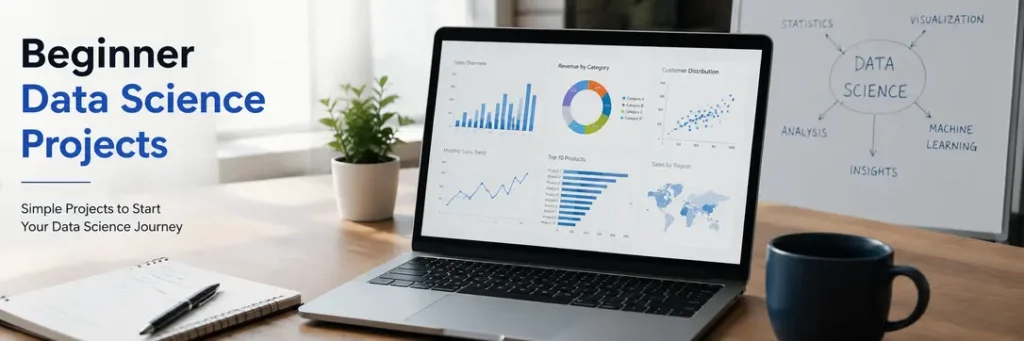
This is the right place to start. Not because they’re easy, but because they teach the fundamentals you’ll use in every project after. Most people skip this phase and then wonder why their intermediate projects feel shaky.
1. Exploratory Data Analysis on a Public Dataset
Pick a dataset from Kaggle or the UCI ML Repository. Could be Netflix shows, COVID stats, or IPL cricket data. Run EDA on it: check distributions, find missing values, look for correlations, and build 5 to 8 charts that tell a story.
Skills used: Python (Pandas, Matplotlib, Seaborn), data cleaning, and storytelling with charts.
This is unglamorous work. But it’s also 80% of what data scientists actually do at their jobs. Learn to love it. If you’re just starting out and want structured guidance, a solid data science course in Noida will walk you through EDA properly before anything else.
Project Link: Exploratory Data Analysis Project
2. House Price Prediction
A regression project using the Boston Housing dataset or Kaggle’s Ames Housing data. Predict house prices from features like area, location, number of rooms, and year built. Add feature engineering: try log-transforming skewed columns, encode categoricals, and test whether adding interaction terms improves your RMSE.
Skills used: Linear Regression, Ridge/Lasso, feature engineering, Scikit-learn, and Pandas.
It’s a classic for a reason. Regression is fundamental, and explaining the model’s outputs to a non-technical person is a skill in itself. Can you tell someone why your model thinks that a 3-bedroom house is overpriced? That explanation matters more than your R² score.
Project Link: House Price Prediction Project
Get Free Demo Class ➔3. Email Spam Classifier
Build a classifier that tells you whether an email is spam or not. Use the Enron email dataset or the UCI Spam dataset. Preprocess the text (lowercasing, removing stop words, and stemming), vectorize it with TF-IDF, and train a Naive Bayes or logistic regression model. Then check where it fails.
Skills used: Natural Language Processing, TF-IDF vectorization, Naive Bayes, and logistic regression.
This introduces you to text data, which most real-world data science roles deal with constantly. A good Python course in Noida will give you the string manipulation and library knowledge you need to handle messy text at scale.
Project link: Email Spam Classifier Project
4. Customer Churn Prediction
Which telecom customers are about to leave? Build a classifier using a telecom churn dataset (Kaggle has a good one). Go beyond just building the model: analyze which features drive churn the most. Tenure? Monthly charges? Contract type? The business insight is what makes this worth putting on your resume.
Skills used: Decision Trees, random forests, class imbalance handling (SMOTE), and feature importance.
This one is popular among data scientist resume projects because it maps directly to a business problem any interviewer understands. Every company with a subscription model has this problem. Every single one.
Project link: Customer Churn Prediction Project
5. COVID-19 Data Analysis and Visualization
Pull public COVID data (Our World in Data is great for this) and build a dashboard or series of charts tracking case trends by country, vaccination rates, and mortality over time. Add annotations for major events: lockdowns, variant surges, and vaccine rollouts.
Skills used: Pandas, Plotly, time-series visualization, and data wrangling.
The storytelling matters as much as the code here. Can you surface a real insight? Something that would make a reader stop and think? That’s the whole game. Anyone can make a line chart. Making one that says something is harder.
Project link: COVID-19 Data Analysis and Visualization Project
Intermediate Data Science Projects
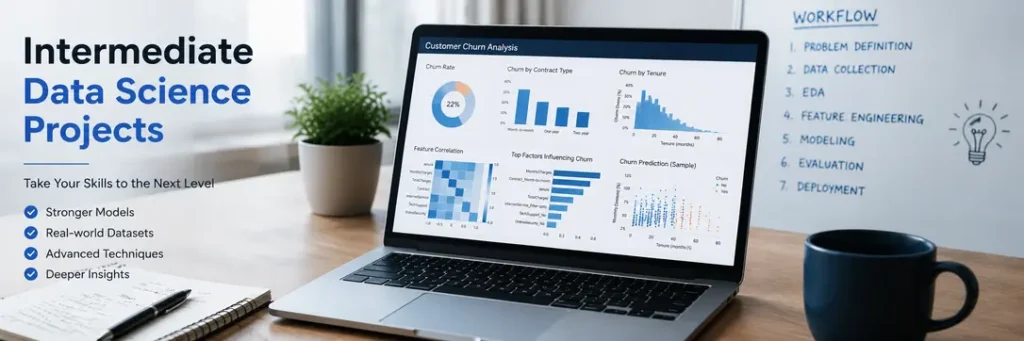
You’ve got the basics. Now you want to work on projects on data science that involve real complexity, messier data, and decisions that aren’t obvious from a tutorial.
6. Sentiment Analysis on Twitter or Product Reviews
Scrape tweets or use Amazon product reviews. Build a model that classifies sentiment as positive, negative, or neutral. Start with rule-based tools like VADER, then compare against a trained ML model. If you want to go further, fine-tune a BERT model and compare results.
Skills used: NLP, TextBlob or VADER, BERT (optional), data collection via API, and Scikit-learn.
If you go the BERT route, this starts crossing into intermediate-to-advanced territory fast. The gap between VADER accuracy and a fine-tuned BERT is usually dramatic, and showing that gap in your writeup tells a strong story.
Project Link: Sentiment Analysis on Twitter or Product Reviews Project
7. Movie Recommendation System
Build a collaborative filtering model using the MovieLens dataset. Users who liked Inception also liked Interstellar. Model that relationship using matrix factorization. Add a content-based component using genre and cast metadata, and compare the two approaches.
Skills used: Matrix factorization, cosine similarity, Surprise library, and Python.
Recommendation systems are everywhere. Having one in your portfolio shows you understand user behavior modeling, not just prediction. That’s a different kind of thinking, and interviewers notice it.
Project Link: Movie Recommendation System Project
8. Credit Card Fraud Detection
This is an imbalanced classification problem. Most transactions are legit; very few are fraud. That’s the whole challenge. A model trained naively will just predict “not fraud” every time and look 99.9% accurate. Your job is to make it actually useful.
Skills used: Anomaly detection, SMOTE, XGBoost, precision-recall curves, and Python.
Use precision-recall AUC, not accuracy, to evaluate your model. Talk about that choice in your README. Understanding evaluation metrics beyond accuracy is what separates people who’ve actually worked with real data from those who’ve only done toy problems.
Project Link: Credit Card Fraud Detection Project
9. Image Classification with CNN
Use CIFAR-10 or MNIST. Build a convolutional neural network to classify images into categories. Try building one from scratch first, then use transfer learning with a pretrained ResNet or VGG model and compare the results.
Skills used: TensorFlow or PyTorch, CNNs, GPU training, data augmentation, and transfer learning.
This is where you touch deep learning properly for the first time. It’s also where a good ML course in Noida pays off, since the theory behind CNNs (convolutions, pooling, backprop) isn’t obvious from tutorials alone. Reading a blog about backpropagation and actually implementing it are very different experiences.
Project Link: Image Classification with CNN Project
10. Stock Market Price Prediction
Use historical OHLC data from Yahoo Finance via the yfinance library. Predict the next-day closing price using LSTM or ARIMA. Add technical indicators like RSI, MACD, and Bollinger Bands as features.
Skills used: Time-series forecasting, LSTM, ARIMA, feature engineering, and Pandas.
A word of honesty: this is notoriously hard to do well. The point isn’t to beat the market. The point is to work with sequential data, understand the limitations of your model, and talk intelligently about why perfect prediction is impossible. That maturity shows up well in interviews.
Projects Link: Stock Market Price Prediction Project
11. Fake News Detection
Build a classifier using labeled news articles. Can your model tell real news from fabricated stories? Use datasets like LIAR or FakeNewsNet. Experiment with article title only vs. full text, and analyze which types of fake news your model consistently misses.
Skills used: NLP, TF-IDF, LSTM, BERT, Scikit-learn.
This one gets attention in portfolios because it’s socially relevant and the problem is genuinely hard. A model that’s 85% accurate on the test set but fails completely on political satire is an interesting finding. Write about that failure honestly. Hiring managers respect intellectual honesty far more than inflated accuracy numbers.
Project Link: Fake News Detection Project
12. Sales Forecasting for Retail
Use a dataset like Walmart’s sales data from Kaggle. Predict weekly sales per store and department. The interesting part: model how holidays (Thanksgiving, Christmas, and Super Bowl) affect sales patterns differently across store types.
Skills used: Time-series analysis, XGBoost, feature engineering, holiday effects, and Pandas.
This maps directly to a problem every retail and e-commerce company has. Framing the project around a business decision (“which stores need more inventory in Q4?”) makes it land better than just presenting a loss curve.
Project Link: Sales Forecasting for Retail Project
Advanced Data Science Projects
These are the ones that get you noticed. Strong advanced data science projects require combining multiple skills, working with real-world messy data, and shipping something that actually runs outside a notebook.
13. End-to-End ML Pipeline with Deployment
Pick any classification or regression problem. Build the model, track experiments with MLflow, wrap it in a Flask or FastAPI app, containerize it with Docker, and deploy it to AWS EC2 or Heroku. Add a simple front-end form that takes input and returns a prediction.
Skills used: Model deployment, Flask/FastAPI, Docker, AWS/GCP, REST APIs, MLflow.
Most data science projects for the portfolio stop at the Jupyter notebook. This one doesn’t. The deployment is the differentiator. Any company that uses ML in production needs people who know what happens after the model is trained.
Project Link: End-to-End ML Pipeline with Deployment Project
14. Natural Language Question Answering System
Fine-tune a BERT or GPT-based model on a QA dataset like SQuAD. Build a system that reads a document and answers questions about it. Test it on domain-specific text like legal documents or medical records to see where it breaks.
Skills used: Hugging Face Transformers, fine-tuning, tokenization, Python.
This type of project signals you can work with large language models, which is where most AI hiring is focused right now. Even a basic fine-tuned BERT on SQuAD 2.0 shows you understand the full transformer pipeline.
Project link: Natural Language Question Answering System project
15. Real-Time Twitter Sentiment Dashboard
Stream live tweets using the Twitter API and classify sentiment in real time. Display results in a live-updating Streamlit or Dash dashboard showing sentiment trends by keyword or hashtag.
Skills used: Apache Kafka or PySpark Streaming, real-time NLP, Dash or Streamlit, and API integration.
Real-time data pipelines are a completely different beast from batch processing. This project shows you understand data engineering, not just modeling. That combination is rare and highly valued in mid-size and enterprise data teams.
Project Link: Real-Time Twitter Sentiment Dashboard Project
16. Face Recognition System
Build a face detection and recognition pipeline using OpenCV and deep learning. Detect faces in images, extract embeddings using FaceNet or DeepFace, and match them against a reference set.
Skills used: Computer Vision, OpenCV, FaceNet or DeepFace, and Python.
For anyone targeting computer vision roles, this is close to mandatory in your portfolio. The challenge is getting it to work reliably across varying lighting, angles, and image quality. Document those failure cases.
Project Link: Face Recognition System Project
17. Customer Segmentation with RFM Analysis and Clustering
Use e-commerce transaction data like the Online Retail dataset from UCI. Calculate each customer’s Recency, Frequency, and Monetary scores, then apply K-Means and DBSCAN. Use PCA to visualize the clusters. Assign business-readable labels: “loyal high spenders,” “at-risk dormant,” and so on.
Skills used: K-Means, DBSCAN, PCA, customer analytics, and Pandas.
The business framing is everything here. Raw cluster labels (0, 1, 2, 3) mean nothing. Translating them into actionable customer segments is where the actual data science work happens, and it’s the part that shows hiring managers you can communicate results.
Project Link: Customer Segmentation with RFM Analysis and Clustering Project
18. Healthcare Diagnosis Prediction
Use the Pima Indians Diabetes dataset or chest X-ray images from Kaggle’s NIH Chest X-Ray dataset. Build a diagnostic classifier, but spend serious time on model evaluation: sensitivity, specificity, and the real-world cost of false negatives.
Skills used: XGBoost, neural networks, class imbalance, ROC-AUC, Scikit-learn, or PyTorch.
Healthcare projects require extra rigor. A false negative in a cancer detection model means a missed diagnosis. Frame your evaluation around that reality, and your project immediately reads at a professional level.
Project Link: Healthcare Diagnosis Prediction Project
19. Autonomous Driving Object Detection
Use a dataset like KITTI or BDD100K. Train a YOLO model to detect cars, pedestrians, cyclists, and traffic signs in dashcam footage. Compare YOLOv5 vs YOLOv8 performance on the same test set.
Skills used: Object detection, YOLO, data annotation, computer vision, and GPU training.
This is a research-adjacent project that signals frontier-level thinking. A strong AI course in Noida covering computer vision fundamentals will make this project significantly easier to approach without starting from scratch.
Project Link: Autonomous Driving Object Detection Project
20. AI-Powered Chatbot with Domain-Specific Knowledge
Build a Retrieval-Augmented Generation (RAG) chatbot using a document corpus. Feed it a company’s FAQ documents, a legal handbook, or a medical textbook. Let it answer questions grounded in that specific knowledge base. Add source citations so users can verify answers.
Skills used: LangChain, OpenAI API or open-source LLMs, vector databases (Pinecone, FAISS), Python.
RAG-based systems are what most production AI applications are actually built on. Knowing how to chunk documents, generate embeddings, store them in a vector DB, and retrieve them at query time is a genuinely employable skill set right now.
Project Link: AI-Powered Chatbot with Domain-Specific Knowledge
What Makes a Data Science Project Portfolio-Worthy
Any project can go in a portfolio. Few projects actually help you get hired. The difference comes down to 3 things.
First, the problem framing. “I built a classifier” is weak. I built a model that predicts which hospital patients are at risk of readmission within 30 days” is specific. Frame every project around the problem it solves, not the technique you used.
Second, the documentation. A GitHub repo with no README is a dead end. Write down what the problem was, what data you used, what you tried, what worked, and what you’d do differently. That writeup is what interviewers actually read.
Third, the honesty about limitations. Every model has weaknesses. Acknowledge them. A candidate who says “my model performs poorly on low-income zip codes and here’s why” is far more credible than one claiming 97% accuracy on a test set without context.
How to Pick the Right Data Science Project
Pick based on where you are, not where you want to be. If you can’t explain linear regression clearly, building a BERT chatbot will teach you nothing. Do the house price prediction first.
For data science projects for beginners, start with EDA, classification, and regression. Get comfortable with Pandas and Scikit-learn before you touch TensorFlow. The fundamentals compound. Time spent on them isn’t wasted.
For data science projects for a portfolio that actually impresses, push toward deployment and business framing. Any model that lives only in a notebook is incomplete. Ship it somewhere, even if it’s just a free Heroku app.
And write about what you built. A GitHub README that explains the problem, your approach, what worked, and what didn’t is worth more than the code itself. That’s the thing hiring managers actually read.
Final Thought
A portfolio with 3 strong, well-documented data science projects beats 15 half-finished notebooks every time. Quality over quantity. Pick one project, take it all the way to deployment or a clean presentation, then move to the next.
The projects above cover every major area: NLP, computer vision, time-series forecasting, recommendation systems, and MLOps. There’s something here whether you’re 3 weeks into your learning journey or 3 years in.
Pick one. Start today. The portfolio won’t build itself.
Read More: 10 Best MERN Stack Projects