If you type “business analyst” into a job portal in Noida or Gurgaon right now, you’ll get thousands of listings. Fresher-friendly, no heavy coding required, and decent starting pay. That’s why so many students and working professionals ask me for a business analyst roadmap that actually works in 2026, not a recycled 2019 checklist with SQL and a smile tacked on.
I’ve trained people moving into this role from three different starting points: fresh graduates with a commerce or engineering degree, working professionals switching from support or operations, and marketers who got tired of running ads and wanted to sit closer to decision-making. The path looks different for each of them. The destination skills don’t.
This is the business analyst roadmap I’d hand a student on day one. No “follow your passion” filler. Just what to learn, in what order, and why it matters.
I train digital marketing and analytics students at an IT institute in Noida, and BA questions come up in nearly every batch now, mostly from people who started in data analytics and realized they enjoy the stakeholder side of the job more than the query side. That shift is common, and this roadmap reflects what’s actually worked for them.
Who actually needs this business analyst career roadmap?
Two groups show up for this role, and they need slightly different plans.
Students and fresh graduates. You’re probably choosing between data analytics, digital marketing, and business analysis. BA sits in a comfortable middle ground: less coding than data science, more strategic weight than a pure reporting job.
Working professionals. You’re in IT support, operations, or even sales, and you want out. A business analyst career roadmap for you runs shorter because you already understand how a business runs day to day. You’re missing the tools and the vocabulary, not the instinct.
Either way, the roadmap for business analyst careers I’m laying out below, assuming 9 to 12 months to get job-ready. Compress it if you move faster. Stretch it if you’re doing this alongside a full-time job.
Get Free Career Counseling ➔The 5-stage business analyst roadmap
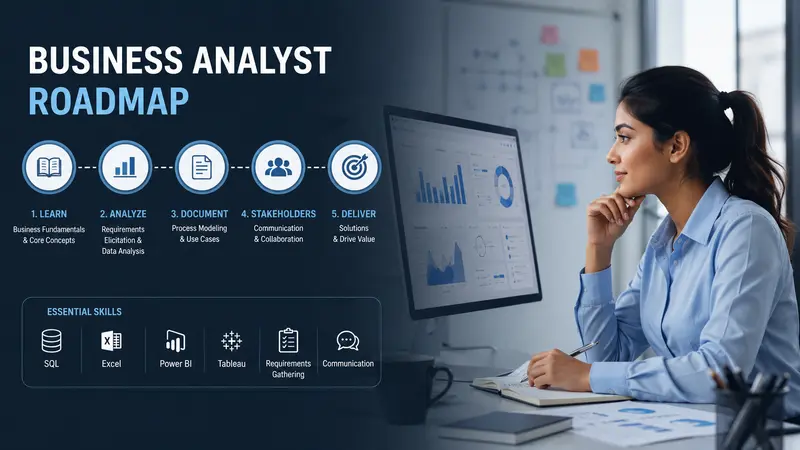
Here’s the whole plan broken into stages. I’ll go deeper on each one right after.
| Stage | Timeline | Main focus | What you’ll have by the end |
|---|---|---|---|
| 1. Foundation | Month 1-2 | Business fundamentals, Excel, documentation basics | A grip on BRDs, FRDs, and how a business actually functions |
| 2. Core tools | Month 3-4 | SQL, Power BI, Tableau, and wireframing tools | Ability to pull data and turn it into a readable chart |
| 3. Domain and methodology | Month 5-7 | Agile, Scrum, one industry domain (banking, retail, healthcare) | A working vocabulary recruiters recognize |
| 4. Certification and projects | Month 7-9 | ECBA or CCBA prep, 2-3 portfolio projects | Proof you can do the job, not just talk about it |
| 5. Job hunt | Month 9-12 | Resume, mock interviews, networking | Interview calls and, ideally, offers |
Notice something: coding barely shows up. A modern business analyst roadmap leans on SQL, not Python. You’ll query databases, not build them.
Stage 1: build the business fundamentals first.
Skip this stage and everything after it wobbles.
Start with how a business actually operates: departments, workflows, stakeholders, and where money and information move. Then learn to write the two documents every recruiter will ask about:
- BRD (Business Requirements Document): what the business wants and why.
- FRD (Functional Requirements Document): how the system will deliver it.
Get comfortable in Excel beyond basic formulas too. Pivot tables, VLOOKUP, and conditional formatting come up in nearly every BA interview I’ve sat in on.
Read a handful of real BRDs if you can find sample ones online. Notice the structure: scope, objectives, stakeholders, functional requirements, and out-of-scope items. Copy that structure into your own practice document before you touch a single tool. Most beginners jump straight to SQL and skip this, then struggle to explain what a requirement document is actually for when an interviewer asks.
Get Free Demo Class ➔Stage 2: the tools that make a business analyst course roadmap worth following
This is where most business analyst course roadmap programs spend the bulk of their hours, and for good reason. Tools are what separate “I understand business” from “I can prove it with data.”
| Tool | What it’s for | Time to get functional |
|---|---|---|
| SQL | Pulling and filtering data from databases | 3-4 weeks |
| Power BI or Tableau | Building dashboards stakeholders actually read | 3-4 weeks |
| Jira or Azure DevOps | Tracking requirements and sprints | 1-2 weeks |
| Balsamiq or Figma (basic) | Wireframing for FRDs | 1 week |
| MS Visio or Lucidchart | Process flow diagrams | 1 week |
You don’t need to master all five before applying. You need working knowledge of at least SQL and one BI tool, plus familiarity with the rest.
If you’re based in Delhi NCR and want structured, hands-on training in the data side of this stack, a data analytics certification course in Noida covers SQL, Excel, and Power BI in a format built around live projects instead of slide decks. That data foundation carries straight into business analysis work, since a big chunk of a BA’s week is spent reading dashboards and questioning what’s behind them.
Stage 3: pick a methodology and a domain.
Agile isn’t optional anymore. Most Indian IT services companies and product firms run Scrum or a Scrum-Kanban hybrid. Learn:
- Sprint planning and backlog grooming
- User stories and acceptance criteria
- The BA’s actual role in a Scrum team, a common point of confusion since it’s a separate role from the Scrum Master
Then pick one domain. Banking and financial services, retail and e-commerce, and healthcare hire the most BAs in India right now.
Banking wants BAs who understand loan workflows, KYC processes, and regulatory reporting. Retail and e-commerce want people who get inventory, order management, and customer journey mapping. Healthcare wants BAs comfortable with compliance-heavy documentation and clinical or insurance workflows.
Going broad feels safer. Recruiters don’t reward it, though. Someone scanning 200 resumes remembers the one that says “requirements gathering for a core banking migration project” over a generic line about “requirements gathering.”
Stage 4: certifications worth the money and ones that aren’t yet
I get asked about this constantly, so here’s the honest version.
Worth it early on:
- ECBA (Entry Certificate in Business Analysis) from IIBA. The exam costs roughly $130 to $170, it’s recognized globally, and it’s built for freshers.
- CCBA, once you have 2 to 3 years of experience.
Worth it later, not now:
- CBAP. Needs 7,500+ hours of documented BA work experience. Skip it until you’re actually eligible.
- PMI-PBA. Solid credential, but PMI wants project hours you won’t have as a fresher.
A certificate alone won’t get you hired. Pair it with 2 to 3 real projects (public datasets, a simulated BRD for a fictional retail chain, whatever you can build) so you have something concrete to walk an interviewer through.
3 portfolio projects that actually get you shortlisted
Certificates get you past the resume filter. Projects get you through the interview. Build 2 or 3 of these before you start applying seriously.
- A requirements package for a fictional retail app. Write a full BRD and FRD for something like a loyalty points feature. Include user stories, acceptance criteria, and one wireframe.
- A dashboard built on a public dataset. Pull a Kaggle dataset (banking churn, retail sales, whatever fits your target domain), clean it in Excel or SQL, and build a Power BI dashboard with 3 to 4 insights a manager could actually act on.
- A process improvement case study. Pick a process you know from your current job or daily life (a college admission workflow, a delivery process, anything with steps and delays) and document the current state, the pain points, and a redesigned “to-be” process.
Put all three in a simple portfolio site or a well-organized Google Drive folder. Link it on your resume. Interviewers ask about this more than they ask about your certification.
Business analyst vs product analyst: what’s the actual difference
People use these titles almost interchangeably in India, and it causes real confusion when you’re job hunting.
A business analyst usually works across the business, translating needs from finance, operations, or sales into requirements for IT or product teams. A product analyst sits inside one product team, focused on user behavior, feature performance, and metrics tied to that specific product.
For someone following a business analyst roadmap, this matters at the application stage. Don’t filter out product analyst roles just because the title looks different. The core skills, SQL, stakeholder communication, and requirements thinking overlap heavily, and many companies use the titles loosely anyway.
Explore Trending Courses ➔How AI tools fit into this roadmap now
Worth addressing directly, since 2026 job descriptions ask for it. Companies increasingly expect BAs to use AI tools like Claude or ChatGPT to draft first-pass BRDs, summarize stakeholder interviews, and generate user stories from raw notes.
This doesn’t replace the analyst. It changes the job slightly. The value shifts toward validating what the AI produces, catching gaps in logic, and asking the sharper follow-up question a model won’t think to ask. If your business analyst roadmap skips this, you’ll be behind candidates who list it on their resume, even at entry level.
What a business analyst salary in India actually looks like in 2026
Numbers vary by source, but the pattern holds across the salary data I’ve cross-checked on AmbitionBox, Naukri, and Indeed. Here’s a rough breakdown by experience.
| Experience | Typical annual salary (India) |
|---|---|
| Fresher (0-1 year) | ₹4 lakh to ₹6.5 lakh |
| Mid-level (3-5 years) | ₹9 lakh to ₹15 lakh |
| Senior / BA lead (8+ years) | ₹18 lakh and above |
City matters too. Bengaluru and Mumbai sit at the top of the range. Noida and Gurgaon trail slightly on average pay but offer a lower cost of living and a dense IT services market, which usually means more entry-level openings to apply to.
Companies like TCS, Accenture, Capgemini, and Genpact hire BAs in volume. Product companies and global capability centers pay more but expect sharper SQL and stakeholder management skills at the interview stage.
Roadmap for business analyst career switchers
If you’re already working, this roadmap for business analyst transitions runs shorter. Not because the content changes, but because you skip the “how does a business work” stage. You already know that from experience.
Focus your 6 to 8 months on:
- SQL and one BI tool, hard.
- A certification (ECBA fits best for switchers).
- One project that maps to your current industry. Worked in banking ops? Build a BA case study around a loan processing workflow. That overlap is your biggest edge over a fresh graduate, so use it.
- LinkedIn and resume repositioning. “Operations executive” needs to read like a business analyst in training within the first 3 lines.
Recruiters like switchers. You already understand deadlines, stakeholders, and how to sit in a meeting without freezing. That’s half the job done before you even start.
Where people go wrong on this roadmap
- Chasing every certification. One entry-level cert plus real project work beats three certificates and zero portfolio pieces.
- Learning Python before SQL. SQL comes up in nearly every BA interview. Python barely does, unless you’re aiming for a data-heavy hybrid role.
- Skipping soft skills prep. Stakeholder interviews, requirement workshops, and client calls make up a real chunk of the job. Practice explaining a technical finding to someone non-technical. It’s a skill, and interviewers test for it.
- Applying only to “Business Analyst” job titles. Titles like Product Analyst, Requirements Analyst, and even some Associate Consultant roles cover the same work.
- Ignoring internal referrals and IT training networks. A large chunk of entry-level BA hiring in Noida and the wider NCR happens through institute placement drives and referrals, not cold applications on job portals. Ask your trainer or course coordinator about active placement partners before you rely purely on Naukri and LinkedIn.
FAQs on the business analyst roadmap
Do I need to know coding to become a business analyst?
No. SQL is expected, but SQL is a query language, not programming in the traditional sense. Python or Java isn’t required for most BA roles.
How long does a business analyst course roadmap usually take?
Most structured programs run 3 to 6 months. Add another 2 to 4 months for certification prep and projects if you’re pacing it yourself.
Is a business analyst career roadmap realistic without an MBA?
Yes. An MBA helps for senior or consulting-heavy roles, but most entry and mid-level BA jobs in India hire on skills and certifications, not the degree behind them.
Which is better for freshers: business analyst or data analyst?
Depends on what you enjoy day to day. Data analyst work leans more technical and numbers-first. Business analyst work leans more on communication, documentation, and translating business needs into requirements. Both use SQL and BI tools, so the early roadmap overlaps quite a bit.
Can I switch to business analyst from a non-IT background?
Yes, and it happens often. Commerce, operations, and even customer support backgrounds transfer well, since stakeholder communication and process thinking matter as much as technical skill.
Follow the stages in order, put in the hours on SQL and one BI tool, and don’t skip the projects. That’s the entire roadmap for business analyst success in 2026. Everything else is timing and interview practice.