If you searched for a machine learning roadmap in 2026, you’re probably tired of listicles that dump 40 YouTube links and call it a day. I get it. This field moves fast, and last year’s advice about “just learn scikit-learn and you’re set” doesn’t hold up anymore.
I’ve watched students and working professionals go through this exact transition at Appwars Technologies in Noida, and the ones who actually land ML roles follow a similar sequence of steps. This is the machine learning roadmap I’d hand to a smart 22-year-old with decent Python skills. It’s also the one I’d hand to a 35-year-old software engineer who wants to pivot without quitting their job.
Who this roadmap for machine learning actually helps
- College students in B.Tech, BCA, or MCA programs who want a job-ready skill before graduation
- Working professionals in software development, data analytics, or even non-tech roles who want to pivot into ML
- Self-taught learners stuck in tutorial loops, jumping from course to course without finishing any of them
If you fall into one of these three buckets, keep reading.
The state of ML hiring in 2026
Companies stopped hiring people who can only import a library and call .fit(). They want people who understand what happens when a model fails silently in production. That shift is why a real machine learning engineer roadmap looks different than it did in 2021.
Three things changed:
- Generative AI ate a lot of the entry-level “build a chatbot” hype. Recruiters now probe fundamentals harder in interviews.
- MLOps became a real job function on its own, not a side task for whoever was free.
- Companies expect candidates to understand production deployment, not just Jupyter notebooks.
The roadmap for machine learning needs to reflect these three shifts. That’s what the rest of this guide is built around.
Get Free Career Counseling ➔Machine learning roadmap 2026: the full breakdown
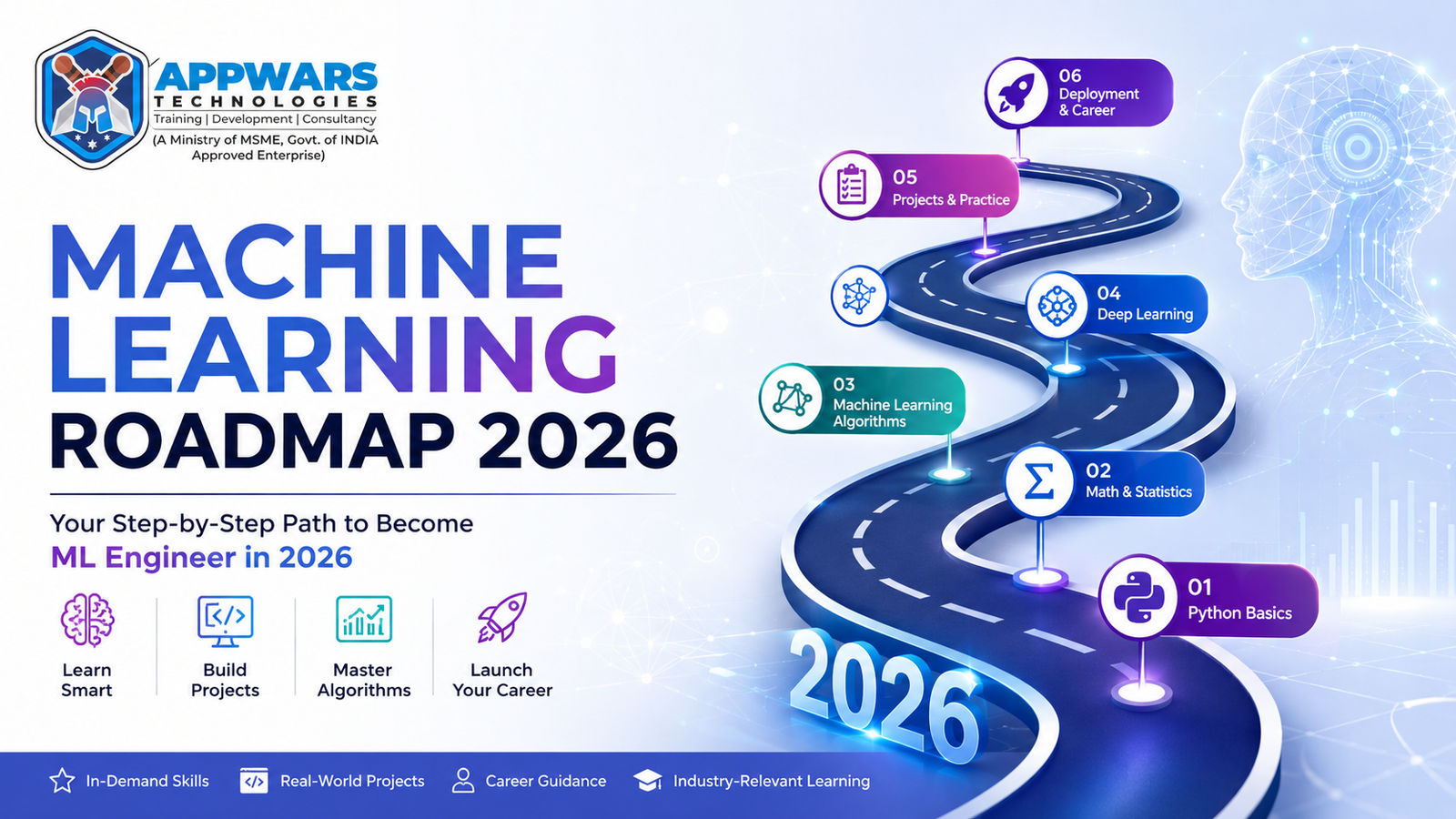
I’m splitting this into 7 phases. Some overlap. That’s fine; you don’t need to finish one phase before touching the next.
Phase 1: Python and math foundations (4 to 6 weeks)
You need Python fluency before anything else clicks. Not “I can write a for loop.” Real comfort with functions, classes, and libraries like NumPy and Pandas.
Math-wise, you need:
- Linear algebra: vectors, matrices, dot products
- Probability and statistics: distributions, Bayes theorem, hypothesis testing
- Calculus basics: derivatives, gradients, the chain rule
Skip the full university-level math course. You need enough to understand why gradient descent works, not enough to prove it on a whiteboard.
Phase 2: Data handling and exploratory analysis (3 to 4 weeks)
A lot of self-taught learners quit around here because it’s not glamorous. Pandas, data cleaning, handling missing values, SQL basics, and visualization with Matplotlib or Seaborn.
Real datasets are messy. A Kaggle CSV that’s already clean teaches you almost nothing about the actual job.
Phase 3: Core machine learning algorithms (6 to 8 weeks)
This is the heart of any machine learning roadmap. Linear regression, logistic regression, decision trees, random forests, SVMs, k-means clustering, and gradient boosting with XGBoost or LightGBM.
Don’t just call sklearn functions and move on. Build one algorithm from scratch, like linear regression with gradient descent in plain NumPy. It changes how you debug models later, because you actually know what’s happening under the hood.
Phase 4: Deep learning (6 to 8 weeks)
Neural networks, backpropagation, CNNs for images, RNNs, and transformers for sequences. Pick PyTorch or TensorFlow and go deep on one instead of learning both shallowly.
PyTorch has more traction in research roles and in most 2026 job postings I’ve come across. TensorFlow still shows up a lot in enterprise settings, especially where teams built on it years ago and never migrated.
Get Free Demo Class ➔Phase 5: MLOps and deployment (4 to 5 weeks)
Most tutorials skip this phase entirely. It’s also the one that separates a machine learning developer roadmap that gets you hired from one that leaves you stuck at “it works on my laptop.”
- Model versioning with MLflow or DVC
- Containerizing models with Docker
- Basic CI/CD for ML pipelines
- Deploying a model as an API with Flask or FastAPI
- Monitoring for model drift once it’s live
Phase 6: Specialization and projects (ongoing)
Pick a lane: computer vision, NLP, recommendation systems, or time series forecasting. Build 3 to 4 projects that solve a real problem, not “predict Titanic survival” for the tenth time.
Recruiters in Noida and Delhi NCR have told me directly that a GitHub with 2 deployed projects beats 15 half-finished notebooks every single time.
Phase 7: Interview prep and certification (3 to 4 weeks)
- Practice explaining the bias-variance tradeoff out loud, not just on paper
- Work through 50 to 100 ML-specific interview questions
- A recognized certification helps clear resume filters, especially if you’re switching careers from a non-tech background
Machine Learning Roadmap at a Glance
| Phase | Duration | Core focus | Key tools |
|---|---|---|---|
| 1. Foundations | 4-6 weeks | Python, linear algebra, statistics | Python, NumPy, Pandas |
| 2. Data handling | 3-4 weeks | Cleaning, EDA, SQL | Pandas, Matplotlib, SQL |
| 3. Core algorithms | 6-8 weeks | Regression, trees, clustering | scikit-learn, XGBoost |
| 4. Deep learning | 6-8 weeks | Neural nets, CNNs, transformers | PyTorch or TensorFlow |
| 5. MLOps | 4-5 weeks | Deployment, monitoring | Docker, MLflow, FastAPI |
| 6. Specialization | Ongoing | Projects, portfolio | GitHub, Streamlit |
| 7. Interview prep | 3-4 weeks | Mock interviews, certification | LeetCode, certifications |
Total timeline: 7 to 9 months if you’re consistent alongside college or a job. Compress it to 4 to 5 months if you can study full time.
What a typical week looks like on this roadmap
People ask me for a schedule more than anything else, so here’s a rough one for someone studying alongside college or a job, roughly 12 to 15 hours a week.
- 2 sessions on core theory: read a chapter, watch one lecture, take notes by hand
- 3 sessions of hands-on coding: rebuild what you just learned in a fresh notebook, no copy-pasting from the source
- 1 session reviewing older material: revisit last month’s project and see what you’d change now
- 1 weekend block for a bigger project push, 3 to 4 hours uninterrupted
Consistency beats intensity here. Five focused hours a week for a year will outperform one manic 40-hour week followed by a burnout month.
Books, courses, and practice platforms worth your time
You don’t need 15 resources. You need 3 or 4 good ones, finished properly.
- Andrew Ng’s Machine Learning Specialization on Coursera, still the best place to build intuition for how algorithms actually work
- “Hands-On Machine Learning with Scikit-Learn, Keras, and TensorFlow” by Aurélien Géron, for implementation depth once theory clicks
- Kaggle, for practice datasets and competitions once you’re past the absolute basics
- Fast.ai, if you want a faster, project-first route into deep learning instead of a slow theory-first climb
Pick one from each category and stick with it. Resource hopping is how people spend two years “learning” without shipping a single project.
Explore Trending Courses ➔Common mistakes on the machine learning engineer roadmap
Jumping into deep learning before you actually understand linear regression is the most common one I see. Neural networks feel exciting, so people rush there and end up debugging models they can’t reason about.
Watching tutorials without typing a single line of code yourself is close behind. Passive learning feels like progress. It isn’t.
A few more that show up constantly:
- Chasing every new tool that trends online instead of finishing one project
- Skipping math entirely, then freezing when interviewers ask “why” instead of “how”
- Building projects nobody would ever use, then wondering why recruiters skim past them
- Treating certifications as the finish line instead of proof you can back up with a working project
For working professionals: fitting this in around a full-time job
You don’t need to quit your job to follow this. Block one hour before work and 4 to 5 hours across the weekend, and you’ll clear most phases in 8 to 10 months without burning out.
Put your current job to use here. If you work in finance, build your first classification project on financial data. If you’re in logistics, try demand forecasting. Recruiters notice when your portfolio connects to a domain you already understand, because it signals you can apply ML to a real business problem, not just a textbook one.
Tell your manager if the switch is public knowledge internally. Some companies will let you shadow their data or ML team for a few hours a month, which is worth more than another course.
For students: weave this into your degree instead of bolting it on.
If you’re still in college, don’t treat this roadmap as separate from your coursework. Use your statistics and linear algebra classes to reinforce Phase 1 instead of learning it twice. Turn your final year project into one of your portfolio pieces from Phase 6, so you’re not doing double work in your last semester.
Start applying for internships the moment you finish. Phase 3. You don’t need deep learning mastery to be useful in an entry-level internship. Plenty of teams need someone who can clean data and build solid baseline models, and that’s exactly what Phases 1 through 3 prepare you for.
Self-taught vs. Structured: Choosing your roadmap to learn machine learning
Self-taught works if you have real discipline and 15 to 20 hours a week to spare. Most people don’t sustain that past month two.
A structured course fixes the biggest problem with self-teaching: nobody catches your mistakes early. If you build a model with data leakage, YouTube won’t flag it for you. A mentor will, usually within the first review of your notebook.
That’s the gap Appwars Technologies tries to close from Noida Sector 2. Our Machine Learning course in noida walks students through this exact 7-phase structure with live projects and a mentor reviewing your code, not just your final output. If you’d rather build a broader base first, our Data science certification in noida program covers ML as part of a wider data stack including Python, statistics, and visualization. And once you’ve cleared the fundamentals, our AI course in noida goes further into deep learning, NLP, and generative AI.
Machine learning career paths and salaries in India (2026)
Numbers vary by city, company size, and how you negotiate, but here’s a rough sense of where the market sits right now:
- ML engineer, 0-2 years: 6 to 10 LPA
- ML engineer, 3-5 years: 12 to 22 LPA
- Data scientist with ML specialization: 8 to 18 LPA depending on experience
- MLOps engineer: 10 to 20 LPA, and this role kept climbing through 2025 into 2026
Noida and Delhi NCR alone have dozens of companies hiring for these roles right now, from mid-size product companies to MNC delivery centers running ML teams out of the region. Fintech, ed-tech, healthtech, and logistics analytics are hiring the most aggressively in the NCR belt right now, and a chunk of that demand is entry-level with training provided on the job.
Building a portfolio that actually gets noticed
Three or four solid projects beat a folder full of half-finished notebooks. Here’s what I’d point a beginner toward:
- A classification project on a real, messy dataset, not the cleaned-up ones bundled with sklearn
- A deep learning project with images or text, deployed as a small web app so someone can actually try it
- An end-to-end MLOps project: train a model, containerize it, deploy it, and set up basic monitoring
- One project in your chosen specialization, built to a standard you’d be proud to demo in an interview
Write a short README for each one explaining the problem, your approach, and what you’d improve given more time. That last part matters more than people think. It shows you can evaluate your own work honestly.
FAQs
How long does it take to complete a machine learning roadmap?
Most people need 6 to 9 months studying 10 to 15 hours a week. Full-time learners can compress this to 4 to 5 months.
Do I need a computer science degree to follow this roadmap for machine learning?
No. I’ve seen commerce graduates and mechanical engineers switch into ML roles. Consistent practice matters more than your degree on paper.
Which language should I learn for machine learning?
Python, and it’s not close. R still shows up in academic and statistics-heavy roles, but Python dominates industry hiring in 2026.
Is machine learning still worth learning with all the generative AI hype?
Yes. Generative AI tools are built on machine learning foundations. Understanding ML makes you better at using and building AI systems.
What’s the real difference between an ML engineer and a data scientist?
A data scientist spends more time on analysis, experimentation, and communicating findings to stakeholders. An ML engineer spends more time building and maintaining the systems that put models into production. Plenty of people end up doing both, especially at smaller companies.
Pick one phase from this roadmap and start this week. The machine learning developer roadmap only works if you’re actually building while you’re reading it.