
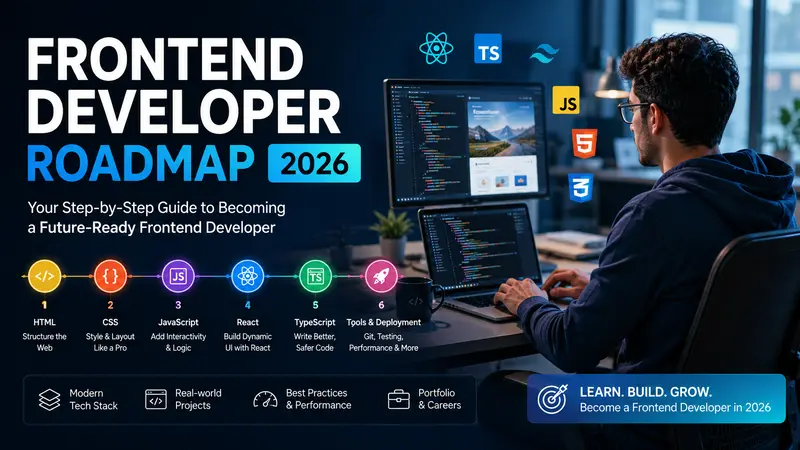
Every “frontend developer roadmap” you find online looks different. Some start with JavaScript. Some jump straight into React and skip HTML entirely. A few throw 15 tools at you in the first paragraph and call it a plan.
None of that gets you hired.
This frontend web developer skills roadmap lays out the exact order to learn things in, why that order matters, and what you can skip. It works whether you’re a college student picking your first tech skill or a working professional planning a shift into web development. It doubles as a general web development roadmap too, just weighted toward the browser-facing skills.
No filler. Just the path.
What a frontend developer actually does in 2026
A frontend developer builds everything a user sees and clicks on a website or app. The layout, the buttons, the forms, the aanimations, andthe part that loads when someone opens a page on their phone at 2 AM with 1 bar of signal.
In 2026, that job has grown. You’re not just writing HTML and CSS anymore. You’re working with component libraries, TypeScript, performance budgets, and AI coding assistants that write half your boilerplate. The core skill hasn’t changed: turning a design into working, fast, accessible code.
Companies hiring frontend developers in India, from Noida startups to Bangalore product teams, expect a working knowledge of modern JavaScript frameworks, version control, and at least basic testing. That’s the bar now.
Why a frontend development roadmap beats random tutorials
I’ve trained students who spent 8 months on YouTube tutorials and still couldn’t build a working to-do app. The problem wasn’t intelligence. It was the lack of a sequence. They’d learn a bit of React on Monday, jump to Figma on Tuesday, then get pulled into a random Rust video on Wednesday.
A frontend roadmap fixes that. It gives you:
- A fixed sequence, so you build on what you already know
- Clear checkpoints, so you know when to move to the next skill
- Real projects at each stage, so the learning actually sticks
Skip the roadmap and expect to restart every few weeks. Follow one and you’ll have a working portfolio in 4 to 6 months.
The complete frontend developer roadmap for 2026, step by step
Here’s the order. Don’t skip steps, even if a step looks basic. Employers test basics in interviews more than most candidates expect.
Step 1: HTML5, the skeleton of every website
Start here. Always. HTML defines the structure of a page: headings, paragraphs, images, forms, and navigation.
Focus on semantic HTML: Tags help screen readers and search engines read your page correctly. Skip them and Google, along with accessibility tools, treats your site like a wall of unlabeled boxes.
Time to spend: 1 to 2 weeks. Build 3 to 4 static pages by hand before moving on.
Step 2: CSS3 and responsive design
CSS handles how things look. Colors, spacing, fonts, and layout.
Learn Flexbox first, then CSS Grid. Together they cover most layout situations you’ll hit on the job. After that, learn media queries so your site works on a phone screen and a 27-inch monitor without breaking.
Skip Bootstrap at this stage. Learning raw CSS first makes you faster later, and interviewers notice the difference.
Time to spend: 2 to 3 weeks.
Step 3: JavaScript (ES6 and beyond)
This is where most beginners slow down. JavaScript is the language that makes your page interactive: dropdowns, form validation, and content that updates without a page reload.
Cover these in order: variables and data types, functions, arrays and objects, DOM manipulation, and events, then ES6+ features like arrow functions, destructuring, and template literals. Promises come next. Async/await comes last, once promises actually make sense.
Build small projects as you go. A calculator. A quiz app. A weather app that pulls from a free API.
Time to spend: 4 to 6 weeks. This is the longest step in the roadmap, and that’s fine.
Step 4: Git and GitHub
Learn version control before you touch a framework. Every job posting for a frontend role in Noida, Gurgaon, or Bangalore lists Git as a requirement, and a lot of beginners treat it as an afterthought.
Cover init, add, commit, push, pull, branches, merge conflicts, and pull requests. Push every project you build to a public GitHub profile. Recruiters check this before they check your resume.
Time to spend: 3 to 4 days to learn the basics, then use it daily from here on.
Step 5: Pick one frontend framework: React
React dominates job listings in India right now, so start there. Vue and Angular are solid options too, but React gets you hired faster in 2026’s market.
Learn components, props, state, hooks (useState, useEffect, useContext), and conditional rendering. Build at least 3 real projects: a to-do app with local storage, a movie search app using a public API, and a small e-commerce product page.
Hold off on Next.js until React itself feels comfortable. Jumping in too early leaves gaps in your fundamentals that show up later.
Time to spend: 5 to 6 weeks.
Step 6: TypeScript
TypeScript adds static types to JavaScript, and by 2026 it’s close to mandatory at mid-size and large companies. It catches bugs before they hit production, and it makes your code easier for a team to read.
Learn interfaces, types, generics, and how to type React props and component state. This step moves fast if your JavaScript fundamentals are solid.
Time to spend: 2 weeks.
Step 7: State management
Once your apps grow past a handful of components, passing props everywhere gets messy. Learn Context API first since it ships with React. Then look at a lighter library like Zustand or Redux Toolkit, depending on what job listings at your target companies ask for.
Time to spend: 1 to 2 weeks.
Step 8: Working with APIs
Real apps talk to servers. Learn fetch and Axios, how REST APIs work, and the basics of GraphQL since more companies use it now for flexible data fetching. Practice handling loading states, errors, and pagination. Tutorials usually gloss over these, and interviewers usually ask about them.
Time to spend: 2 weeks.
Step 9: Testing your code
Most students skip this and pay for it in interviews. Learn Jest and the React Testing Library. Write tests for at least one existing project: component rendering, user interactions, and form validation.
You don’t need deep testing expertise as a junior developer. Knowing the basics still separates you from a pile of resumes that all read the same.
Time to spend: 1 to 2 weeks.
Step 10: Build tools and performance
Learn Vite (faster than Create React App and mostly replaced it by now), basic Webpack concepts, and how to run a Lighthouse audit. Understand code splitting, lazy loading, and image compression. A fast site ranks better, converts better, and interviewers ask about this more than beginners expect.
Time to spend: 1 week.
Step 11: Deployment and CI/CD basics
Deploy your projects. Use Vercel or Netlify for frontend apps, connect your GitHub repo, and set up automatic deployments on push. Learn what a basic CI/CD pipeline does, even before you build one from scratch.
Time to spend: 3 to 5 days.
Step 12: Portfolio, projects, and interview prep
Build a portfolio site with your best 3 to 4 projects, deployed and linked to live GitHub repos. Write clean READMEs. Practice explaining your code out loud, since technical interviews test communication as much as syntax.
Time to spend: ongoing, starting from month 2.
Frontend developer roadmap 2026 at a glance
| Skill | Timeframe | Tools | What you’ll build |
|---|---|---|---|
| HTML5 | Weeks 1-2 | VS Code, Chrome DevTools | Static multi-page site |
| CSS3 and responsive design | Weeks 3-5 | Flexbox, Grid, and media queries | Responsive landing page |
| JavaScript (ES6+) | Weeks 6-11 | VS Code, browser console | Calculator, quiz app, weather app |
| Git and GitHub | Weeks 11-12 | Git CLI, GitHub | Public project repos |
| React | Weeks 12-18 | React, npm/pnpm | To-do app, movie search app, product page |
| TypeScript | Weeks 18-20 | TSC, VS Code | Typed React components |
| State management | Weeks 20-22 | Context API, Zustand/Redux | Multi-page app with shared state |
| APIs (REST/GraphQL) | Weeks 22-24 | Axios, fetch, Postman | App with live data and error handling |
| Testing | Weeks 24-26 | Jest, React Testing Library | Tested components |
| Build tools and performance | Weeks 26-27 | Vite, Lighthouse | Faster-loading app |
| Deployment and CI/CD | Weeks 27-28 | Vercel, Netlify, GitHub Actions | Live, deployed portfolio projects |
| Portfolio and interview prep | Ongoing from month 2 | Personal site, README docs | Job-ready portfolio |
Give or take a few weeks based on how many hours a day you can put in. Students with 4 to 5 hours daily usually clear this frontend engineer roadmap in 6 to 7 months. Working professionals studying part-time take closer to 9 to 12 months, and that’s normal too.
Frontend developer roadmap for working professionals
If you have a job, you don’t get 6 hours a day for this. You get maybe 90 minutes on weekdays and a few hours on weekends, if you’re lucky.
Here’s how to adjust the plan:
- Study in 45- to 60-minute blocks, twice a day if possible, instead of one long weekend session
- Skip the “explore every framework” phase entirely. Pick React and commit
- Build projects tied to problems from your current job. A dashboard, a form, an internal tool. It’s faster to learn something you already understand
- Join a structured course instead of piecing together free content on your own. Working professionals lose more hours to tutorial-hopping than students do, mostly because free time is scarcer and every wrong turn costs more
At Appwars Technologies, we’ve trained working professionals from finance, sales, and even mechanical engineering backgrounds who made the shift in under a year with a fixed schedule and weekend batches.
Common mistakes that slow down your frontend roadmap
- Starting with a framework before HTML, CSS, and JavaScript are solid. This creates gaps that surface in interviews months later
- Watching tutorials without typing the code yourself. Passive learning feels productive and rarely is
- Skipping Git because “I’ll learn it later.” Every team uses it from day one
- Building 10 tiny practice snippets instead of 3 to 4 complete projects. Recruiters want finished work, not fragments
- Ignoring accessibility and performance until a senior developer flags it in code review
Frontend developer salary and career path in India
Entry-level frontend developers in India typically start around 3 to 6 LPA, depending on the city and company size. With 2 to 3 years of experience and a solid GitHub history, that moves to 8 to 14 LPA at product companies. Senior frontend engineers, and those who move into full-stack roles, often cross 18 to 25 LPA, particularly in Bangalore, Gurgaon, and Hyderabad.
Whether you call it a frontend developer roadmap or a frontend engineer roadmap, the destination is the same job. Noida and Delhi NCR have a growing base of IT companies and startups hiring frontend talent, especially in fintech, ed-tech, and SaaS.
How to start your frontend developer roadmap in Noida
If you’d rather learn with a fixed schedule, live projects, and a trainer checking your code instead of piecing together scattered playlists, a classroom or hybrid option can save months. Appwars Technologies runs a web desigining course in Noida that covers this exact roadmap step by step, with hands-on projects and placement support.
What comes after frontend: going full stack
Once HTML, CSS, JavaScript, and React feel solid, a lot of developers move toward full-stack work to widen their job options. If that’s the plan, MongoDB, Express, React, and Node (the MERN stack) is a natural next step since you already know React. Check out our MERN stack developer roadmap for the backend half of that path.
FAQs on the frontend developer roadmap 2026
How long does this frontend developer roadmap take? Most students finish in 6 to 9 months studying 3 to 4 hours daily. Working professionals studying part time usually need 9 to 12 months.
Do I need a computer science degree to become a frontend developer? No. Recruiters care about your projects, your GitHub, and how you perform in a practical interview. A degree helps at some companies but isn’t a requirement at most product and startup teams.
React or Angular for a beginner in 2026? React, for most people. It has a smaller learning curve, more job listings in India, and a bigger community to get unstuck with.
Is frontend development still worth learning in 2026 with AI tools around? Yes. AI tools speed up boilerplate code, but someone still needs to understand the output, catch bugs, and make architectural decisions. That person is the frontend developer.