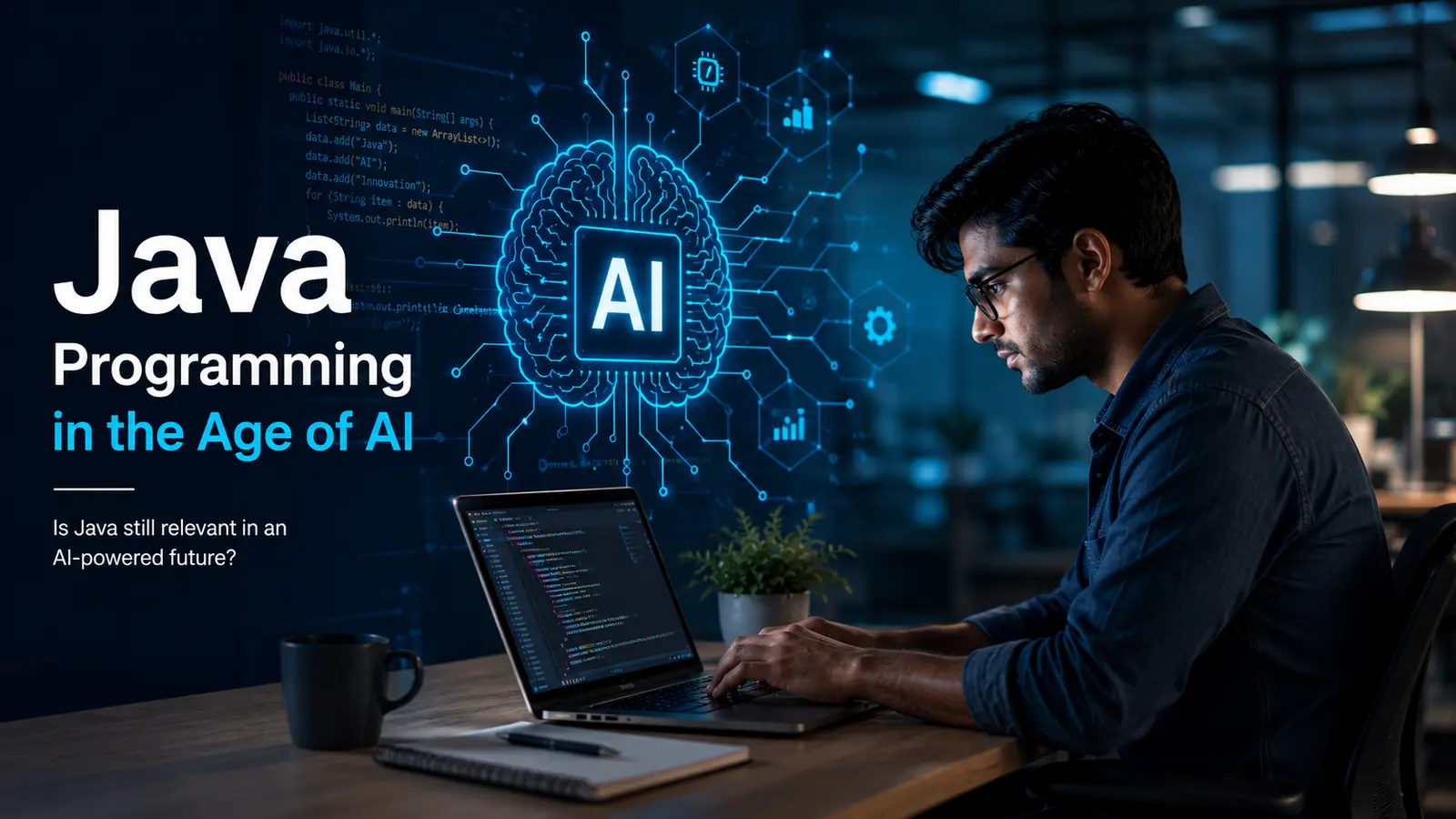
AI tools write code now. They finish your functions, fix your bugs, and sometimes even explain themselves better than the last senior dev who reviewed your pull request. So it’s fair to ask: does Java programming still matter when a chatbot can spit out a working class in 10 seconds?
Short answer: yes. And the reason isn’t nostalgia. Java runs the banking system that moved your last paycheck. It runs the Android app you used this morning. It’s the backbone of half the enterprise software you’ve never heard of but that keeps hospitals, airlines, and government offices running.
This article walks through what’s actually changed, what hasn’t, and whether learning Java programming in 2026 still makes sense once you factor AI into the picture. We’ll cover the industries still betting on Java, how AI tools are reshaping the job itself, the real challenges beginners face, and a practical roadmap to get started.
If you’re planning to build a career in backend or enterprise software development, enrolling in a Java training program can help you learn core concepts, work on real-world projects, and become job-ready.
Why is everyone questioning Java in the AI era?
Software development looks different than it did 5 years ago. AI coding assistants now autocomplete entire methods, generate unit tests, and catch bugs before you’ve even run the code. Tools like GitHub Copilot and Claude have gone from novelty to daily habit for millions of developers.
That shift makes people nervous. If AI can write code, why spend months learning a language with strict syntax rules and a reputation for being verbose?
Here’s the thing though: AI writes code, it doesn’t design systems. It doesn’t decide how a banking platform should handle a failed transaction at 2am. It doesn’t understand why your company’s checkout flow needs to support 3 different payment providers with 3 different failure modes. Someone still has to make those calls, and that someone needs to read, judge, and fix what the AI produces.
AI assists. It doesn’t replace judgment. And Java programming, as a discipline, is still built around judgment.
What makes Java programming relevant even today?
Java has been around since 1995. That’s ancient in tech years. So why hasn’t it died the way other 90s languages did?
Platform independence is a big part of it. Write Once, Run Anywhere isn’t just a slogan, it’s the reason a bank can build one Java application and deploy it across Windows servers, Linux clusters, and mainframes without rewriting core logic for each.
Then there’s the object-oriented structure. Java forces you to think in terms of classes, objects, and clear boundaries between components. That structure scales. A 50,000-line Java codebase written by a team 8 years ago is still readable today, because the language pushes toward organization instead of clever one-liners.
Security matters too. Java’s memory management and strict typing catch entire categories of bugs before they become vulnerabilities. That’s not a small thing when your codebase handles credit card numbers or patient records.
Performance has also improved a lot. Modern JVMs (Java Virtual Machines) optimize code at runtime in ways that rival compiled languages. And the developer community around Java is massive, which means almost any problem you hit, someone else already solved and documented.
Add long-term enterprise adoption to that list. Companies don’t rip out working Java systems just because a newer language exists. Migration is expensive and risky. So the demand for people who understand Java isn’t going anywhere soon, AI or no AI.
Industries that still depend on Java programming
Enterprise software runs on Java more than most people realize. Internal tools, supply chain systems, HR platforms, a huge chunk of that is Java under the hood.
Banking and financial services lean on Java hard. Transaction processing, fraud detection, trading systems, these need reliability above almost everything else, and Java has a 25-year track record of not falling over.
Healthcare systems use Java for patient record management and hospital scheduling software, where a crash isn’t just inconvenient, it’s dangerous.
E-commerce platforms use Java on the backend for inventory management, order processing, and payment handling, often paired with newer frameworks for the customer-facing layer.
Government systems, tax platforms, licensing databases, public records, tend to run on Java because agencies value stability over trendiness. Nobody wants to explain to a legislature why the tax filing system crashed because someone chose an experimental framework.
Cloud applications increasingly use Java through frameworks like Spring Boot, which makes building scalable microservices faster than it used to be.
Android development still has a massive legacy footprint in Java, even though Kotlin is now Google’s preferred language for new apps. Millions of existing apps still run on Java code that needs maintaining.
Big data technologies, Hadoop, Kafka, and a chunk of the Apache ecosystem, are written in Java or run on the JVM. If you want to work in data engineering, Java knowledge helps more than people expect.
How AI is changing Java development
AI hasn’t replaced Java development. It’s changed the daily rhythm of it.
Code completion tools now suggest entire method bodies based on a function name and a comment. That saves real time on boilerplate, and Java has plenty of boilerplate.
Automated testing has gotten smarter too. AI can generate unit tests that cover edge cases a tired developer might skip at 6pm on a Friday.
Debugging is faster when an AI assistant can scan a stack trace and point to the likely cause in seconds instead of you scrolling through logs for 20 minutes.
Documentation generation is another win. AI can draft Javadoc comments and README files from existing code, which used to be the task everyone put off until the sprint review reminded them.
Productivity is genuinely higher for developers who use these tools well. But here’s the part that doesn’t change: you still need to understand what the generated code does. If you can’t read a stack trace or explain why a NullPointerException happened, an AI suggestion is just a black box you’re trusting blindly. Java fundamentals are what let you catch the AI when it’s wrong, and it is wrong sometimes.
Advantages of learning Java in 2026
The job market for Java developers is still strong. Job boards consistently show thousands of open Java developer roles, and that number hasn’t dropped the way some predicted when AI coding tools went mainstream.
Salary potential holds up too. Experienced Java developers, especially those who know Spring Boot and cloud deployment, command competitive pay in most markets, because companies need people who can maintain and extend systems that already generate revenue.
Career stability is a genuine advantage here. Java isn’t a trend. It’s infrastructure. Infrastructure jobs don’t disappear overnight.
Cross-platform development is baked into the language, so skills transfer across industries without much friction.
And the transition path is smooth. Learn core Java well, and moving into Spring Boot, backend development, cloud services, or microservices architecture becomes a natural next step rather than starting over.
Challenges of learning Java
Let’s be honest about the downsides too.
Java has a steeper learning curve than Python. Where Python lets you print “Hello World” in one line, Java makes you write a full class with a public static void main method just to do the same thing. That trips up beginners constantly.
The syntax is verbose. You’ll type more characters to do the same job compared to Python or JavaScript. Some days that feels like busywork.
You also need to genuinely understand object-oriented programming concepts, classes, inheritance, polymorphism, encapsulation, before Java starts making sense. Skipping that step and just memorizing syntax leads to code that works by accident, not by design.
How do you get past this? Build small projects early instead of just reading theory. Write a basic calculator, then a to-do list app, then something that talks to a database. Concepts stick when you use them, not when you read about them for the fifth time.
Java vs AI: will AI replace Java developers?
Let’s break this down honestly, category by category.
On raw coding, AI is fast. It writes syntax quicker than most humans type. But on problem-solving, especially the kind that requires understanding a business’s specific constraints, AI still needs a human to frame the problem correctly first.
Creativity in system design is still a human strength. AI can suggest a design pattern, but deciding which architecture fits a company’s 5-year growth plan takes context AI doesn’t have.
Debugging is a mixed bag. AI catches obvious errors fast. Complex, environment-specific bugs, the kind that only show up under production load at 3am, usually still need a human who understands the whole system.
Business logic and human decision-making remain firmly human territory. AI doesn’t sit in stakeholder meetings. It doesn’t know why the client insisted on a weird edge case for compliance reasons. That knowledge shapes code in ways no prompt can fully capture.
Put simply: AI is a productivity tool. It’s not a replacement for a developer who understands both the code and the problem the code is solving.
Skills every Java developer should learn alongside AI
Core Java is non-negotiable. Get comfortable with syntax, OOP principles, and the standard library before anything else.
Data structures and algorithms matter more than ever, because AI can generate code, but you need to judge whether that code is efficient or a performance disaster waiting to happen.
Spring Boot has become close to a requirement for backend roles. It’s the framework most Java jobs expect you to know.
REST APIs, SQL, and databases round out the backend skillset. Almost every real application needs to talk to a database and expose data through an API.
Git and GitHub are how teams collaborate on code without stepping on each other. Learn this early, not as an afterthought.
Docker and basic cloud fundamentals (AWS, Azure, or Google Cloud) are increasingly expected, since most modern Java applications get deployed in containers on cloud infrastructure.
AI coding tools deserve a place on this list too. Learning to use them well, and learning basic prompt engineering, the skill of writing clear, specific instructions to get useful output from an AI, will make you faster without making you dependent.
Java learning roadmap for beginners
Start with Java basics: variables, data types, loops, and conditionals. Get comfortable with the syntax before moving forward.
Move into object-oriented programming concepts next. Classes, objects, inheritance, interfaces. This is the foundation everything else builds on.
Learn collections, ArrayLists, HashMaps, and how to store and manipulate groups of data efficiently.
Study exception handling so your programs fail gracefully instead of crashing without explanation.
Get into multithreading once the basics feel solid. Concurrent programming is where a lot of beginners struggle, so don’t rush this stage.
Learn JDBC to connect Java applications to databases, then study SQL directly so you understand what’s actually happening under the hood.
Move on to Spring Boot, the framework most professional Java development happens in today.
Build REST APIs so you can create backend services that other applications, or your own frontend, can talk to.
Build actual projects. A blog platform, a task manager, an inventory system, anything that forces you to combine everything you’ve learned.
Learn Git and GitHub for version control, and get comfortable with deployment basics, how to actually get your application running somewhere other than your laptop.
Finally, layer in AI-assisted development. Use tools like Copilot or Claude to speed up repetitive work, but only after you understand what the code they generate actually does.
Common mistakes beginners make
Skipping fundamentals is the biggest one. Jumping straight into frameworks like Spring Boot without understanding core Java leaves you unable to debug anything when it breaks.
Avoiding projects is another. Reading tutorials feels productive. It isn’t the same as building something that doesn’t work at first and figuring out why.
Memorizing syntax instead of understanding concepts causes problems down the line. You can copy a for-loop from a tutorial, but if you don’t understand what it’s doing, you can’t adapt it to a new problem.
Ignoring version control until it’s too late is a classic mistake. Learn Git from day one, not after you’ve lost a week of work.
And depending too much on AI tools is a real risk for beginners specifically. If you let AI write every function before you’ve built the muscle to write one yourself, you end up unable to spot when the AI is wrong, which happens more often than the marketing suggests.
Conclusion
AI hasn’t made Java programming obsolete. It’s changed how developers work, not whether they’re needed. The banks, hospitals, e-commerce platforms, and government systems running on Java today aren’t getting rewritten just because a chatbot can autocomplete a function.
If you’re weighing whether Java is still worth learning, the honest answer is yes, especially if you pair it with AI tools instead of avoiding them. Learn the fundamentals first: OOP, data structures, how the JVM actually works. Then layer in Spring Boot, cloud basics, and AI-assisted development on top.
The developers who’ll struggle aren’t the ones who learned Java. They’re the ones who skipped the fundamentals and leaned entirely on AI to fill the gap. Build real projects, understand what your code does, and use AI as a tool that makes you faster, not a replacement for knowing your craft.
Frequently asked questions
1. Is learning Java worth it in 2026?
Yes. Enterprise demand for Java developers remains strong, and the skills transfer well into cloud, backend, and Android development.
2. Should I learn Java or Python first?
Depends on your goal. Python is easier to start with and dominates AI and data science. Java is stronger for enterprise backend roles, Android development, and large-scale systems. Many developers end up learning both.
3. Is Java still worth learning given how much AI can automate?
Yes, because AI writes code faster but doesn’t understand systems, business context, or architecture the way a trained developer does.
4. Is Java used in AI?
Not as the primary language, Python dominates AI and machine learning. But Java shows up in production AI systems, especially where performance and scalability at enterprise level matter, through libraries like Deeplearning4j.
5. Is Java good for AI development specifically?
It’s not the first choice, but it’s a solid secondary skill if you’re building AI features inside larger Java-based enterprise applications.
6. Is Java developer a good career choice?
Yes. Steady demand, competitive salaries, and a clear path into senior backend, architecture, or cloud roles.
7. Can I learn AI concepts starting from Java as my base language?
Yes, though you’ll likely need to pick up Python alongside it, since most AI and machine learning libraries are Python-first.
8. Can AI replace Java developers?
No. AI replaces some repetitive coding tasks. It doesn’t replace the judgment, system design, and business understanding a Java developer brings.
9. Is Java difficult for beginners?
It has a steeper learning curve than Python due to its verbose syntax and strict OOP requirements, but it’s very learnable with consistent practice and project work.
10. Which industries use Java the most?
Banking, healthcare, government, e-commerce, and enterprise software all rely heavily on Java.
11.What is the salary of a Java developer?
It varies widely by location and experience, but Java developers with Spring Boot and cloud skills tend to earn above-average salaries compared to general backend roles.
12. How long does it take to learn Java?
Basic proficiency takes 3 to 6 months of consistent practice. Job-readiness with frameworks like Spring Boot usually takes closer to 8 to 12 months.
13. Can I become a Java developer without a computer science degree?
Yes. Plenty of working Java developers are self-taught or came through bootcamps. What matters more is a solid portfolio of projects and a clear understanding of fundamentals.
Also read this article- How to start a career in ai