I get this question almost every week in class now. A student pulls up two LinkedIn posts, one calling 2026 “the year of agentic AI,” the other still hyping ChatGPT-style tools, and asks me to settle it.
So let’s settle it.
Generative AI and agentic AI solve different problems. Mixing them up in an interview or a job description costs you credibility fast, and recruiters in Noida and Gurgaon are asking about both right now.
This post breaks down generative ai vs agentic ai in plain terms: what each one actually does, how they work under the hood, real examples you can point to, and which skill set is worth building first if you’re a student or a working professional switching into AI.
Both terms surfaced within about 18 months of each other. Both get called “AI” in headlines, course brochures, and job postings alike. Treating them as synonyms is exactly the mistake that gets people caught out in an interview.
What is generative AI?
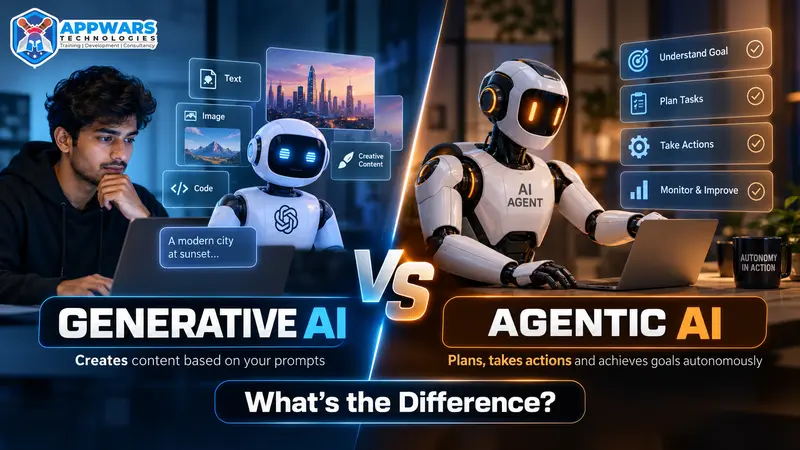
Generative AI creates content. Text, images, code, video, and audio: if you give it a prompt, it produces an output.
ChatGPT writes an email. Claude drafts a report. Midjourney paints an image from a sentence. Sora turns a paragraph into a short video clip. That’s the whole job: put in a prompt, and get a finished piece of content back.
Under the hood, a generative model predicts the next most likely word, pixel, or token based on patterns it learned from training data. It runs once, top to bottom, then stops. It doesn’t check its own output against a database, book anything, or verify a fact on its own.
I tell my students to think of generative AI as a well-read intern. Hand it a topic, and it writes something coherent in seconds. But it won’t check your calendar, send the draft to your manager, or follow up next week. It waits for your next prompt.
In our evening batches, working professionals often ask ChatGPT to draft things like a resignation letter or a tricky client email. It hands back a solid draft in seconds. It won’t check your notice period, look at your actual contract, or send anything anywhere. You still open your email client and hit send yourself. That’s generative AI, start to finish.
What is agentic AI?
Agentic AI acts. Give it a goal, not a single instruction, and it works out the steps on its own.
Say: “Find every blog post on my site with 2025 in the title and update the year.” A generative tool hands you a checklist. An agentic tool opens your CMS, searches the posts, edits each one, and reports back when it’s done.
That’s the real agentic ai vs generative AI split: one drafts, the other executes.
Tools like LangGraph, CrewAI, and n8n let developers build agents that plan a task, call outside tools (APIs, databases, and browsers), check whether each step worked, and adjust when something breaks. Cursor’s agent mode writes code, runs the tests, reads the failures, and fixes its own bugs before showing you the result. Platforms like Salesforce Agentforce and Microsoft Copilot Studio package this same loop for people who don’t write code.
A language model still does the reasoning underneath all of it. Agentic AI is generative AI wired up with memory, tools, and a loop that lets it act more than once instead of stopping after one response.
A finance team’s monthly expense reports make a good second example. Instead of someone checking 200 receipts against a policy PDF by hand, an agent reads each receipt, checks it against the reimbursement policy, flags anything over the limit, and drops the approved ones straight into the payment queue. A person only reviews the 15 or 20 exceptions the agent flags, not all 200.
Generative ai vs agentic AI: the core difference
Here’s the comparison I put on the board in every batch that asks about this.
| Factor | Generative AI | Agentic AI |
|---|---|---|
| Core job | Produces content from a prompt | Completes a multi-step task toward a goal |
| Human input needed | One prompt per output | One goal, then it runs on its own |
| Memory across steps | Usually none; each prompt starts fresh. | Holds context and state across the task |
| Tool use | Rare, mostly text or image output | Calls APIs, databases, browsers, other software |
| Output check | None built in | Checks its own results and retries on failure |
| Example tools | ChatGPT, Claude, Midjourney, Sora | LangGraph, CrewAI, Cursor agent mode, n8n, Agentforce |
| Best for | Drafting, brainstorming, summarizing, designing | Automating workflows, research tasks, and support resolution |
| Failure mode | A wrong or made-up answer in one output | A wrong decision that compounds across several steps |
That last row matters more than most people give it credit for. A bad paragraph from a generative model is annoying. A bad decision three steps into an agentic workflow, one the system then acts on without asking, can cost real money.
How each one actually works
Generative models train on huge amounts of text, images, or audio. They learn statistical patterns: which word tends to follow which, which pixel arrangement looks like a face, and which chord follows which in a melody.
Send a prompt, and the model runs one pass, predicting output step by step until it’s done, then hands it to you.
Agentic systems add a loop on top of that same model. The pattern most frameworks follow: perceive the current state, plan the next step, act using a tool, observe the result, and repeat until the goal is met or a human steps in.
That loop is where the real engineering happens. Handling a failed API call, deciding when to ask a human for approval, knowing when to stop retrying: an orchestration layer wrapped around the model handles all of that.
Difference between generative ai and agentic ai: real use cases
Let’s make this concrete with situations you’d actually run into at work or on a project.
A student writing a blog draft.
Open ChatGPT, ask for an outline, and get one back. Generative AI: one prompt, one output; you edit the rest by hand.
A marketing team running 50 social posts a week.
An agent connected to a scheduling tool checks the content calendar, drafts captions, resizes images for each platform, schedules the posts, and flags anything that needs sign-off. That’s agentic ai vs generative AI inside one job: the first produces a caption, and the second runs the whole pipeline.
Customer support.
A generative chatbot answers “What’s your refund policy?” from a script. An agentic system, the kind built on platforms like Decagon or Sierra, looks up the order, checks the return window, processes the refund, and emails the customer, all without a human touching the ticket.
Coding.
Ask ChatGPT to write a function; that’s generative. Turn on Cursor’s agent mode and ask it to fix a failing test suite across 12 files, and it reads the errors, edits the files, reruns the tests, and keeps going until they pass. That’s agentic.
Gartner has projected that around 40% of enterprise applications will run task-specific AI agents by the end of 2026. Whatever the exact number turns out to be, the hiring direction is already clear: companies are staffing for the second column of that table, not just the first.
Agentic ai vs generative AI: which one should you learn first?
Learn generative AI first. Every agentic system runs on a language model underneath, so prompt design, understanding hallucination, and knowing how these models fail are skills you need before you can debug an agent that’s misbehaving.
Start with prompt engineering: writing clear instructions, structuring a prompt for consistent output, and spotting when a model is making things up. Move into Python next, since almost every agent framework (LangChain, LangGraph, CrewAI) is Python-first. Add API basics after that: calling a REST endpoint, reading a JSON response, and handling an error when a call fails.
Once those three are solid, agentic AI is a natural next step, not a separate field to start over in.
What job postings actually ask for
Scan listings on Naukri or LinkedIn for “AI” roles in Delhi NCR right now, and a pattern shows up fast:
- Marketing and content roles still list prompt engineering and generative AI tools (ChatGPT, Claude, Midjourney) as the baseline requirement
- Automation and operations roles increasingly name specific agent frameworks: LangChain, n8n, CrewAI, or “AI agent orchestration.”
- Even non-technical roles in support and sales operations now mention “AI agent tools” as a plus, not a technical must-have
- The highest-paying listings ask for both: someone who can write a good prompt and also wire that model into a working, multi-step system
Job descriptions are a decent leading indicator here. When “agentic” starts showing up next to “prompt engineering” in a support-operations posting, that’s the market telling you where the next raise is coming from.
Students at Appwars Technologies who take our Data Science Course in Noida already cover the Python and API fundamentals this path needs. From there, our Generative AI Course in Noida walks through prompt design and model behavior before students touch anything agentic. Working professionals coming from a non-technical background usually take this route instead of jumping straight into agent frameworks.
Skills that actually matter for each
For generative AI work:
- Prompt engineering and iteration
- Understanding model limits: hallucination, context windows, token limits
- Content workflows: writing, editing, and image and video prompt design
- Basic evaluation: telling a good output from a confidently wrong one
For agentic AI work:
- Python, since most frameworks are built on it
- REST API basics and authentication
- Debugging a multi-step process when step 4 breaks step 7
- Designing guardrails: when to let an agent act, when to require human approval
Look at the overlap. People building agents start with generative AI fundamentals first, every time. The foundation is the same model, just wrapped differently.
Common mistakes people make with agentic ai
Treating it like magic tops the list. An agent that “figures things out on its own” still runs on a model that can misread a task or misjudge a step, and now it’s taking action instead of just suggesting one.
Skipping guardrails runs a close second. Letting an agent send emails, spend money, or edit production code with zero human checkpoint is how a small mistake in step 2 turns into a real problem by step 6.
Cost blindness catches people too. Every step in an agent’s loop is a model call. A workflow that looks simple on a whiteboard can run 15 to 20 calls behind the scenes, and that adds up fast at scale.
Skipping an audit trail is the quiet one. When an agent takes 15 actions across 3 connected systems and something goes wrong, you need a log of exactly what it did and why, not a guess pieced together after the fact.
Frequently asked questions
Is ChatGPT generative or agentic AI?
Generative, by default. Its agent mode and similar features add a thin agentic layer on top, letting it browse or use tools, but the base product is a generative model responding to prompts.
Can agentic AI work without generative AI?
No. Every agentic system runs a language model at its core for reasoning and planning. That’s the difference between generative ai and agentic ai in one sentence: agentic AI is generative AI plus a loop, memory, and tool access, built on top of it rather than built to replace it.
Which pays more, generative AI skills or agentic AI skills?
Agentic AI skills currently command a premium, since fewer people can design and debug multi-step agent systems than can write a good prompt. That gap will likely narrow as more training catches up.
What’s the easiest way to start learning agentic AI?
Get comfortable with prompt engineering and Python first. Then build one small agent, something like an email summarizer that checks your inbox and drafts replies, using a beginner-friendly framework like n8n or LangChain.
Do I need to learn both eventually?
If you want to work seriously in AI over the next few years, yes. Most roles today still lean generative: content, marketing copy, and support scripts. The roles paying the most already expect agentic AI fluency layered on top of that same foundation.
Where does this leave you?
Generative AI writes. Agentic AI acts. Hold that one-line distinction, back it with a real example instead of a definition, and you’re already ahead of most people throwing generative ai vs agentic ai around on LinkedIn without knowing the difference.
If you’re picking where to start, the path runs through generative AI fundamentals first. Skipping that step to jump straight into agent frameworks means debugging problems you don’t have the background to diagnose yet.