SEO Interview Questions and Answers 2026
Prepare with 25 SEO interview questions and answers for freshers and experienced candidates. Tables, scenarios and Google's latest guidance included.
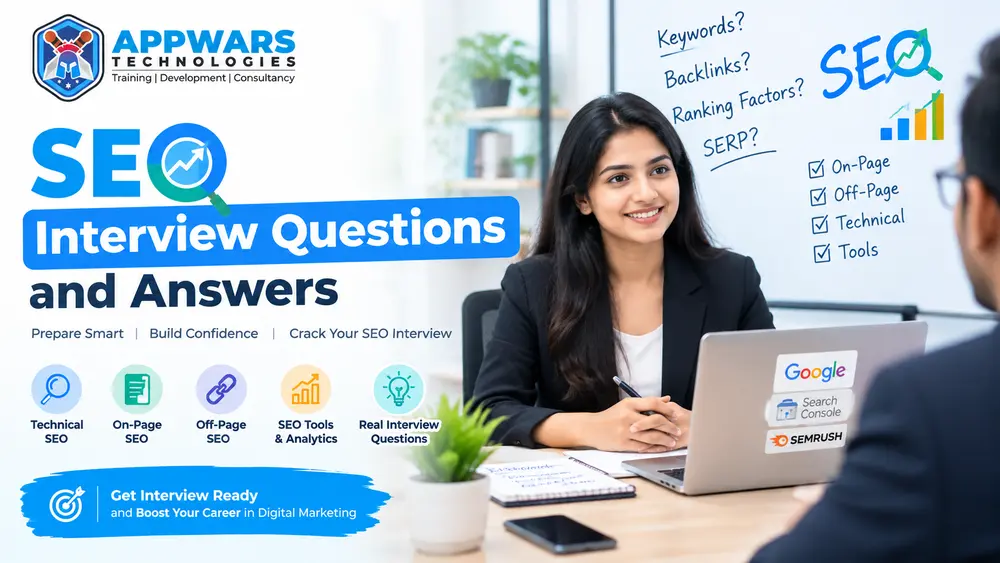
SEO interview questions look easy until someone asks you to back an answer with a real example. That's where most candidates stall.
This guide covers 25 SEO interview questions and answers that I'd expect in 2026. They're split into freshers, technical, advanced and scenario rounds. Each answer is written the way you'd say it out loud: short, specific, with a reason attached.
I'm Pradhumn Mishra, a digital marketing trainer at Appwars Technologies in Noida. I teach SEO to students and working professionals, and these answers come from the questions our batches keep running into after their interviews.
Use this page as an SEO interview question answer revision sheet. Memorising it word for word backfires, because interviewers can tell.
How an SEO interview usually runs
Most companies test you in 3 to 5 steps. The table shows what each step looks for.
| Round | What They Test | Sample Question |
|---|---|---|
| Screening Call | Basic SEO knowledge and communication skills. | What is SEO, and how does Google rank a page? |
| Technical Round | Crawling, indexing, and website speed. | How would you fix pages that are crawled but not indexed? |
| Tools Round | Knowledge of Search Console, GA4, Screaming Frog, Ahrefs, or Semrush. | How would you identify keyword gaps against a competitor? |
| Case Round | Problem-solving and decision-making under pressure. | Organic traffic dropped by 30% last month. What would you check first? |
| Manager Round | Reporting, communication, and ownership. | How would you explain SEO results to someone who doesn't understand SEO? |
Two things have changed recently. Google confirmed its second broad core update of 2026 in May, and AI Overviews and AI Mode now sit above many results. So expect questions on helpful content, E-E-A-T and how your pages get cited in AI answers.
SEO interview questions and answers for freshers
If you're applying for a first SEO job, this section matters most. Interviewers want clear definitions plus one example each.
1. What is SEO?
SEO (search engine optimization) is the practice of making a website easier for search engines to crawl, understand and rank so the right people find it through unpaid results.
I usually add one line about the goal. Rankings are a means. Qualified visits, leads and sales are the result.
2. How does Google Search work?
Three steps. Google crawls pages by following links, indexes the content it finds, and ranks indexed pages when someone searches.
A page can fail at any step. If Googlebot can't reach it, it isn't crawled. If it's crawled but thin or duplicated, it may not be indexed. If it's indexed but weak against competing pages, it won't rank.
3. What is the difference between on-page, off-page and technical SEO?
| Type | What It Covers | Examples |
|---|---|---|
| On-Page SEO | Optimisation of content and elements within a webpage. | Title tags, headings, internal links, image alt text, and content depth. |
| Off-Page SEO | Signals and activities that build a website's authority outside the website. | Backlinks, brand mentions, digital PR, and reviews. |
| Technical SEO | How a website is structured, accessed, crawled, and indexed by search engines. | Website speed, crawlability, indexing, structured data, and mobile usability. |
4. What is search intent, and why does it matter?
Search intent is the reason behind a query. The four common types are informational, navigational, commercial and transactional.
If someone searches "SEO course in Noida" and your page is a 3,000-word history of SEO, you've missed the intent. Google will rank a page that matches it.
5. What are meta titles and meta descriptions?
The meta title is the clickable headline in search results. The meta description is the short summary under it.
Titles influence rankings and clicks. Descriptions don't directly affect rankings, but a good one lifts click-through rate. Google may rewrite either, so write them to match the page honestly.
6. What is a backlink, and what makes one good?
A backlink is a link from another site to yours. A good one comes from a relevant, trusted page, sits naturally inside useful content, and sends real visitors.
One link from an industry publication usually beats 50 from directories that get no readers.
7. What is a canonical tag?
A canonical tag tells Google which version of a page is the preferred one when similar or duplicate URLs exist. It's common on e-commerce sites where filters create dozens of URL variations for one product.
8. What is the difference between robots.txt and an XML sitemap?
Robots.txt tells crawlers which areas they shouldn't crawl. An XML sitemap lists the URLs you want them to find.
A common trap: robots.txt blocks crawling, but it doesn't reliably keep a page out of the index. For that, use a noindex tag.
9. What is E-E-A-T?
E-E-A-T stands for Experience, Expertise, Authoritativeness and Trustworthiness. It comes from Google's quality rater guidelines and describes what Google wants its systems to reward.
Trust sits at the center, and Google doesn't treat E-E-A-T as one ranking factor. In practice it means named authors, real credentials, first-hand examples, accurate facts, clear contact details and sources you can check.
10. What is the difference between dofollow, nofollow, sponsored and UGC links?
Dofollow is the default link. Google also supports three rel attributes: nofollow for links you don't want to vouch for, sponsored for paid placements, and ugc for user-generated content like comments and forum posts.
Google treats these as hints, not strict commands.
Technical SEO interview questions and answers
Technical rounds separate people who've read about SEO from people who've fixed things. Bring examples.
11. What are Core Web Vitals?
They're Google's page experience metrics, measured on real users.
| Metric | Measures | Good Score |
|---|---|---|
| LCP (Largest Contentful Paint) | Measures how quickly the main content of a webpage loads. | 2.5 seconds or less |
| INP (Interaction to Next Paint) | Measures how quickly a webpage responds to user interactions, such as clicks and taps. | 200 milliseconds or less |
| CLS (Cumulative Layout Shift) | Measures the visual stability of a webpage while it loads. | 0.1 or less |
INP replaced FID in March 2024. If a candidate still says FID, the interviewer notices.
12. What is crawl budget?
Crawl budget is the number of URLs Googlebot is willing and able to crawl on your site in a given period. It mostly matters for large sites with tens of thousands of URLs.
Waste comes from duplicate URLs, endless filter combinations, redirect chains and soft 404s. Fixing those helps important pages get crawled sooner.
13. What is the difference between a 301 and a 302 redirect?
A 301 is permanent and passes signals to the new URL. A 302 is temporary, so Google may keep the old URL indexed.
Use a 301 for migrations and merged pages. Avoid redirect chains, because every extra hop slows users and crawlers.
14. What is structured data, and which types do you use?
Structured data is code (usually JSON-LD) that labels what a page contains, such as an article, organization, product, review or breadcrumb.
Be careful here. Google has reduced rich results for FAQ and removed HowTo, so don't promise a visual boost. Use markup because it helps machines understand the page, and only mark up what is visible to users.
15. What is mobile-first indexing?
Google predominantly uses the mobile version of a page for indexing and ranking. If your mobile page hides content, drops internal links or loads slowly, your rankings follow it down.
16. How do you handle hreflang?
Hreflang tells Google which language or regional version of a page to show to which audience. Each version must point to the others and to itself, with matching return tags. Missing return tags are the most common error.
Advanced SEO interview questions and answers
These are the advanced SEO interview questions and answers that separate mid-level candidates from juniors. Expect them if you claim 2 or more years of experience.
17. How do you diagnose JavaScript SEO problems?
Start with the URL Inspection tool in Search Console and compare the rendered HTML with the raw source. If key content, links or canonical tags appear only after JavaScript runs, you've found risk.
Server-side rendering or pre-rendering usually fixes it. Then confirm with a crawl that renders JavaScript.
18. How would you plan a site migration?
My checklist, in order:
- Crawl the old site and save every URL, title and ranking page
- Map each old URL to one new URL (301 redirects, one hop)
- Test everything on staging, including robots rules and canonicals
- Launch with the new XML sitemap submitted in Search Console
- Monitor crawl errors, indexing and traffic daily for the first 2 weeks
Expect a short dip. A long one means a mapping mistake.
19. What is log file analysis, and why do it?
Server logs record every request, including Googlebot's. They show which URLs Google actually crawls, how often, and which return errors. Search Console shows samples. Logs show the full picture.
20. How do you get your pages cited in AI Overviews and AI Mode?
There's no separate trick. Google's own guidance on generative AI features says the same fundamentals apply: crawlable pages, helpful original content, clear structure and a good page experience.
What I do in practice:
- Answer the question directly near the top of the page
- Add original data, examples or first-hand experience that a summary can't copy
- Keep entities, authors and facts consistent across the site
- Track impressions and clicks in Search Console, since click-through can fall even when you're cited
21. How do you respond to a core update?
First, don't panic-edit. Core updates roll out over weeks and rankings move around while they do.
After the rollout ends, compare affected pages against Search Console data. Look for pages that lost visibility, check whether they truly satisfy the query better than competitors, and improve depth, accuracy and authorship. Google's advice has been consistent: make people-first content.
22. Does Google penalize AI-written content?
Google's position is that how content is produced matters less than whether it helps people. But mass-producing pages mainly to rank falls under its scaled content abuse policy.
My rule: AI can draft, a subject expert must verify, add experience and put their name on it.
23. What is the difference between internal linking and site architecture?
Site architecture is the overall structure: how pages are grouped and how deep they sit. Internal linking is the set of links that connect them.
Good architecture keeps key pages within 3 clicks of the homepage and groups related content into topic clusters. A hub page links to supporting articles, and those articles link back.
Scenario-based SEO interview questions
Scenarios test thinking. Say your steps out loud.
24. Organic traffic dropped 30% last month. What do you do?
Work from the widest cause to the narrowest.
| Step | Check | Tool |
|---|---|---|
| 1 | Is it real? Compare against seasonality and tracking changes. | GA4, Search Console |
| 2 | Did it start on a known date? Match it to a Google update or a site release. | Search Console, release notes |
| 3 | Which pages and queries lost clicks? | Search Console Performance Report |
| 4 | Is there a technical issue, such as noindex, robots.txt changes, redirects, or server errors? | URL Inspection, crawler |
| 5 | Did competitors or AI Overviews take the result? | Manual SERP check |
Then fix the cause and report what you found along with what you changed.
25. A page is "crawled, currently not indexed." Now what?
This status usually means Google saw the page and didn't think it was worth storing yet. Check for thin or duplicate content, weak internal links and low uniqueness.
Add depth and original information, link to it from strong pages, then request indexing once. Clicking the button repeatedly changes nothing.
SEO tools questions you should expect
| Tool | What Interviewers Ask |
|---|---|
| Google Search Console | Explain the Performance report, Page Indexing, and URL Inspection. |
| GA4 | How would you measure organic conversions and landing page quality? |
| Screaming Frog | How would you find broken links, redirect chains, and missing titles? |
| Ahrefs or Semrush | How would you identify keyword gaps, audit backlinks, and research competitors? |
| PageSpeed Insights | Explain the difference between lab data and field data. |
If you haven't used these, practise on a real site before the interview. Our SEO course in Noida includes live projects for this reason.
Mistakes that cost candidates the job
- Quoting outdated facts, like FID or meta keywords
- Promising rankings. No one can guarantee a position 1
- Giving definitions with no example
- Ignoring search intent while talking about keywords
- Saying "I don't know" and stopping. Say how you'd find out instead
A 7-day plan to prepare
| Day | Focus |
|---|---|
| 1 | Basics: Crawling, indexing, ranking, and search intent |
| 2 | On-Page SEO: Titles, headings, internal links, and content |
| 3 | Technical SEO: Core Web Vitals, canonicals, redirects, and robots.txt |
| 4 | Off-Page SEO: Backlinks, digital PR, and brand mentions |
| 5 | Tools: Hands-on practice with Search Console and GA4 |
| 6 | Scenarios: Practice an SEO audit of any website |
| 7 | Mock Interview: Practise answering questions out loud |
Reading about how search is changing helps too. Our guide on what XEO is and how it differs from SEO, GEO and AEO covers the newer terms. If you're moving into paid work as well, see the Google Ads course in Noida. For conversion-focused roles, read our Conversion Rate Optimization Roadmap.
FAQs on SEO interview questions
What are the most common SEO interview questions for freshers?
Expect "What is SEO?", on-page versus off-page SEO, how Google crawls and indexes, what a backlink is, and what meta tags do. Be ready to name one tool you've used.
How do I prepare for advanced SEO interview questions and answers?
Practise on a real website. Audit it in Search Console, run a crawl, and write down 3 fixes with expected impact. Specific examples beat theory in advanced rounds.
Is SEO still a good career in 2026?
Yes. Search now includes AI Overviews and AI Mode, which means companies need people who understand content quality, technical health and measurement. The role is changing, not disappearing.
Do I need a certificate to get an SEO job?
A certificate helps get shortlisted, but a portfolio of audits and results carries more weight in the interview.
How long does it take to learn SEO well enough for an interview?
With daily practice, 2 to 3 months covers the fundamentals and tools. Structured digital marketing training with live projects speeds that up.
Final word
Good answers to SEO interview questions share one trait: they're specific. Name the tool, the page, the number, the fix.
Practise the 25 questions above out loud, audit one real site, and walk in with an example for every answer. If you want guided practice and mock interviews, explore the courses at Appwars Technologies.

Pradhumn Mishra
Verified PublisherHe is an SEO specialist and content writer with 4+ years of experience in blogging, content marketing, SEO, and content editing. He has worked across the IT and EdTech industries. Pradhumn specializes in creating SEO-friendly, user-focused content that drives organic traffic and improves search rankings. His mantra is simple: keep it clear, make it memorable, and create content that both readers and search engines love
Related Topics & Keywords
Related Articles You Might Like
More guides in Digital Marketing
 Digital Marketing
SEO course vs social media marketing course
SEO course vs social media marketing course: compare syllabus, skills, salary and careers. Use the 7-day test to pick the right fit.
 Digital Marketing
Conversion Rate Optimization Roadmap: Scratch to Advanced
Follow this conversion rate optimization roadmap to go from CRO basics to advanced A/B testing. Tools, tables, formulas and a 12-week plan.
 Digital Marketing
What Is XEO? Full Form and Difference from SEO, GEO, AEO
XEO has no single official full form. Learn the 4 common meanings, how XEO differs from SEO, GEO and AEO, and how to use it in 2026.