Want to learn programming but don’t know where to start? Or maybe you’ve already tried a few free YouTube tutorials and hit a wall the moment you had to build something real on your own. That gap between watching someone code and actually writing code yourself is where most beginners get stuck.
If you’re searching for the best Python course in Noida with placement support, you’re probably tired of courses that dump theory on you for weeks and call it “practical learning.” Python remains one of the most in-demand programming languages on the planet, and for good reason. It’s used in web apps, data science, automation scripts, AI models, and almost everything in between.
But knowing that Python is valuable and knowing how to actually learn it well are two different problems. That’s where expert-led, project-based Python training in Noida makes a real difference. When you’re guided by trainers who’ve shipped real projects and shown how to debug real errors, the learning curve stops feeling so steep.
What is Python and Why is It So Popular?
Python is a high-level, general-purpose programming language built around readability. Guido van Rossum released it back in 1991, and one of his core goals was making code that reads almost like plain English. That’s still its biggest selling point today.
The syntax is beginner-friendly. You don’t need semicolons at the end of every line, and indentation (not curly braces) defines your code blocks. For someone learning to code for the first time, that removes a whole category of confusing errors.
Python also comes packed with libraries for almost anything you’d want to build. Need to analyze data? Pandas and NumPy have you covered. Building a website? Django and Flask handle the backend. Training a machine learning model? TensorFlow and PyTorch are Python-first.
Companies prefer Python because it cuts development time. A task that might take 50 lines in Java often takes 10 in Python. Netflix, Instagram, Spotify, and Google all rely on it in some part of their stack, and that kind of adoption trickles down into hiring demand everywhere, including right here in Noida.
Why Learn Python in 2026?
Industry demand for Python developers hasn’t slowed down, and honestly, it’s grown broader. It’s no longer just “the language data scientists use.” It’s the connective tissue behind AI and machine learning projects, automation pipelines, cloud deployments, and even cybersecurity tools.
AI and machine learning teams build almost everything in Python first, then optimize later. If you want any foothold in that space, Python is your entry ticket. Data science teams use it daily for cleaning, analyzing, and visualizing information that businesses actually act on.
Automation is another big one. Companies are automating repetitive tasks, report generation, testing, and even parts of DevOps, and Python scripts sit at the center of most of that work. On the web development side, frameworks like Django power everything from startups to enterprise platforms.
Cybersecurity teams write Python scripts to scan for vulnerabilities and automate security checks. Cloud computing platforms like AWS and Azure offer Python SDKs as a first-class option for automation and infrastructure management. Put all that together, and a solid Python programming course in Noida sets you up for more career paths than almost any other single skill you could learn right now.
Who Should Join Python Training in Noida?
Beginners with zero coding background are a great fit. Python’s simple syntax means you’re not fighting the language while trying to learn logic and problem-solving at the same time.
Students still in college benefit from adding a marketable skill before they graduate. A resume with a completed Python course in Noida and a few real projects stands out more than a plain academic transcript.
Graduates hunting for their first job often find that companies want proof of practical skills, not just a degree. Working professionals from other technical backgrounds, say a tester or a support engineer, use Python training with placement in Noida to pivot into development or data roles without starting from scratch.
Non-technical learners, including people from finance, marketing, or operations, are picking up Python to automate their own reporting and analysis work. Entrepreneurs use it to build MVPs without hiring a full dev team upfront. And freelancers add Python to their toolkit because clients pay well for automation scripts, scrapers, and small backend tools.
Skills You’ll Learn During Python Training
Good Python training in Noida starts with the fundamentals: syntax, indentation rules, and how the interpreter actually runs your code. From there, you move into variables and data types, learning how Python handles strings, integers, floats, lists, tuples, and dictionaries.
Loops and functions come next. You’ll write for loops and while loops, then move into writing your own reusable functions instead of copy-pasting code everywhere. This is usually where things click for a lot of learners, because you start seeing how a program is actually structured.
Object-oriented programming (OOP) concepts follow: classes, objects, inheritance, and encapsulation. These aren’t just academic terms. They’re how real-world Python applications, from Django web apps to automation frameworks, are actually organized.
File handling and exception handling round out the core skills. You’ll learn to read and write files, and more importantly, handle errors gracefully instead of letting your program crash. Modules and packages teach you how to organize larger projects and reuse code across files.
APIs are a big one for practical work. You’ll learn to pull data from external services and connect your Python code to the outside world. Database connectivity, usually with SQLite or MySQL, teaches you to store and retrieve data properly. And Git basics give you version control skills that every single employer expects, no exceptions.
Real Projects You Can Build During Python Training
A calculator app is often the first project, and it sounds basic, but it teaches you functions, input handling, and error checks in one small package. It’s the “hello world” of applied logic.
A student management system takes things further. You’re now working with data structures, file storage, and maybe a simple database, while building something that mirrors real business software.
A library management system pushes you into OOP territory: books, members, and transactions each become their own class. It’s a natural next step once you understand objects and inheritance.
A weather app introduces APIs. You’ll pull live data from a weather service and display it, which is a genuinely useful experience since so many real jobs involve integrating third-party APIs.
A to-do list app is small but great for practicing file handling or database storage, since you need to persist data between sessions. An expense tracker takes that further, adding calculations, categorization, and maybe some basic data visualization.
A web scraper teaches you to pull structured data off websites, a skill that’s in constant demand for research, pricing analysis, and lead generation. And finally, a portfolio project, something bigger that combines several of these skills, becomes the centerpiece you show off in interviews. Recruiters care far more about what you’ve built than what you say you know.
Career Opportunities After Learning Python
Here’s a realistic look at where a solid Python programming course in Noida can take you, based on current industry hiring patterns in India.
| Job Role | Required Skills | Average Salary (India) | Experience Level |
| Python Developer | Core Python, OOP, Git, APIs | ₹4-8 LPA | Entry to Mid |
| Backend Developer | Django/Flask, databases, REST APIs | ₹5-10 LPA | Entry to Mid |
| Data Analyst | Pandas, NumPy, SQL, visualization | ₹4-9 LPA | Entry to Mid |
| Data Scientist | Statistics, ML libraries, SQL | ₹8-16 LPA | Mid to Senior |
| Machine Learning Engineer | TensorFlow/PyTorch, math, deployment | ₹10-20 LPA | Mid to Senior |
| Automation Engineer | Scripting, Selenium, CI/CD basics | ₹5-11 LPA | Entry to Mid |
| Software Engineer | Python, data structures, algorithms | ₹6-12 LPA | Entry to Mid |
| AI Engineer | Deep learning, NLP or CV, cloud tools | ₹10-22 LPA | Mid to Senior |
Salaries shift based on company size, city, and your project portfolio, so treat these as ballpark figures rather than guarantees. Still, the range shows why so many freshers and working professionals are choosing Python training with placement in Noida as their next move.
Why Choose Appwars Technologies for Python Training in Noida?
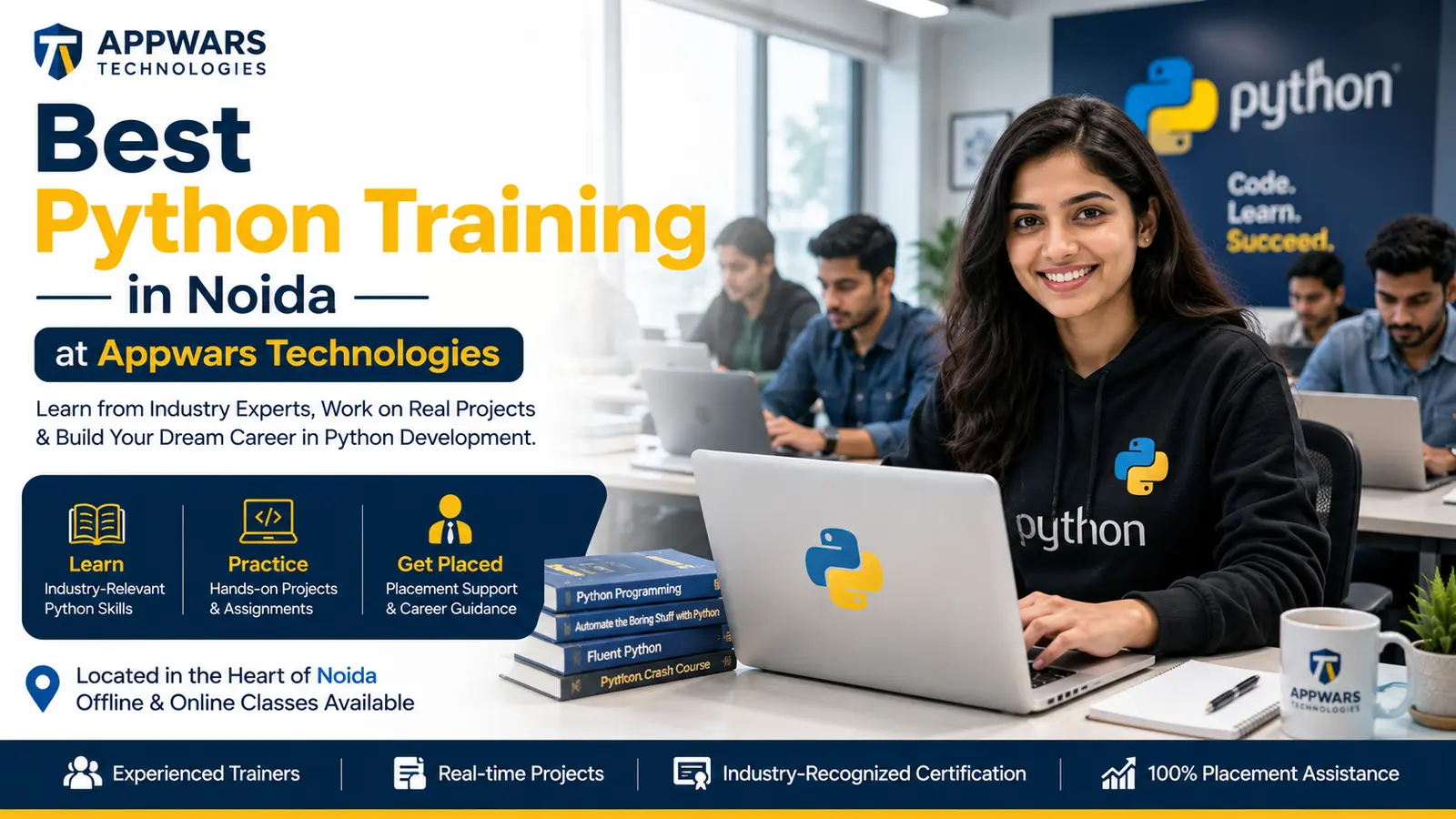
Trainers at Appwars Technologies come with real industry experience, not just teaching credentials. That matters because they can explain why a piece of code works a certain way in production, not just how to pass a classroom exercise.
The curriculum stays focused on what companies are actually hiring for right now, rather than a static syllabus that hasn’t changed in years. Hands-on live projects and practical assignments make up a large chunk of the course, so you’re writing code every single week, not just watching demos.
Batch sizes stay small enough that trainers can actually answer your questions instead of rushing through slides. Interview preparation and resume building are baked into the later stages of the course, so you walk out with more than just certificates.
Placement assistance connects learners with hiring partners looking specifically for freshers and career changers with practical Python skills. Certification adds a credential to your resume, and flexible class timings mean working professionals can join evening or weekend batches without quitting their day job. If you’re comparing options for the best Python training institute in Noida, these details are worth checking against whatever else you’re considering.
Classroom vs Online Python Training
Classroom training gives you face-to-face interaction with trainers and classmates, which helps a lot when you’re stuck on a bug and want an immediate answer. There’s also a structure to physical classes that keeps many learners more disciplined than they’d be on their own.
Online Python training in Noida (or anywhere) offers flexibility that’s hard to beat, especially for working professionals juggling a job and a course at the same time. You can attend from home, rewatch recorded sessions, and set your own pace to some extent.
Practical sessions work well in both formats, honestly, as long as the institute actually runs live coding exercises rather than just screen-sharing slides. The real difference comes down to your own learning style. If you thrive on in-person accountability and quick clarification, classroom training suits you better. If your schedule is unpredictable or you’re managing a full-time job, online batches make more sense.
Tips for Choosing the Best Python Training Institute in Noida
Check whether the curriculum has been updated recently. Python and its ecosystem move fast, and a course still teaching outdated library versions or skipping topics like APIs isn’t doing you any favors.
Look into trainer experience specifically, not just their job titles. Ask how many years they’ve spent actually building software versus just training. Student reviews on Google and Justdial give you an unfiltered look at what past learners actually experienced, so read a handful before deciding.
Ask about the placement record directly: how many students from recent batches actually got placed, and in what kind of roles. Live projects matter more than any other single factor, since that’s what separates job-ready learners from people who can only recite syntax.
Take a demo class before committing. It tells you more about teaching style and course quality than any brochure ever could. Confirm what certification you’ll receive at the end, and compare fees against the actual value you’re getting, not just the sticker price. The cheapest Python course in Noida isn’t always the best deal if it skips projects, mentorship, or placement support entirely.
Conclusion
Learning Python in 2026 isn’t just about following a trend. It’s a language that opens doors across web development, data science, automation, and AI, and that range is exactly why so many students, freshers, working professionals, and career changers are choosing it as their next skill.
The path matters as much as the language itself. Structured, expert-led, project-based Python training in Noida turns theoretical knowledge into the kind of practical skill employers actually pay for. If you’re ready to stop watching tutorials and start building real projects, explore Python Training in Noida at Appwars Technologies and take the next step toward a career you’ll actually enjoy showing up for.
Frequently Asked Questions
1. Is Python good for beginners?
Yes. Its readable syntax and gentle learning curve make it one of the best first languages, especially compared to languages like C++ or Java that throw more complexity at you upfront.
2. How long does it take to learn Python?
Basic fluency typically takes 2 to 3 months with consistent practice. Building real project experience and job-ready skills usually takes 4 to 6 months, depending on how much time you can dedicate weekly.
3. Do I need coding experience?
No. Most Python training in Noida programs, including at Appwars Technologies, are designed for complete beginners and build up gradually to advanced topics.
4. What jobs can I get after learning Python?
Roles like Python developer, backend developer, data analyst, automation engineer, and software engineer are all accessible after a solid Python programming course in Noida, especially once you’ve built a few real projects.
5. Is Python in demand in India?
Very much so. It’s consistently among the top requested skills on Indian job portals, spanning IT services, startups, product companies, and even non-tech industries automating their workflows.
6. What is the average Python developer salary?
Entry-level Python developers in India typically earn between ₹4 and ₹8 LPA, with salaries climbing significantly for specialized roles like machine learning engineering or AI engineering as experience grows.
7. Does Python training include live projects?
At Appwars Technologies, yes. The course is structured around hands-on projects like calculators, management systems, weather apps, and web scrapers, not just recorded lectures.
8. Which is the best Python training institute in Noida?
That depends on your priorities, but look for institutes with experienced trainers, updated curriculum, real placement support, and live project work. Appwars Technologies checks these boxes for learners wanting a genuinely practical Python course in Noida.
Also read this article- 10 Best Python Training Institutes in Noida